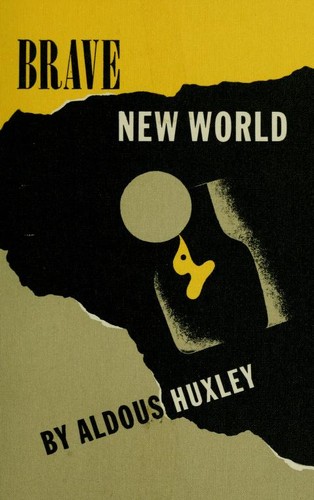
Brave New World
Aldous Huxley (1932)
“A world where everyone is happy, no one suffers, and something irreplaceable has been destroyed.”
Brave New World— Essay Questions & Discussion Prompts
Essay Questions & Food for Thought
30questions designed to challenge assumptions and provoke original thinking. These can't be answered from a summary — you need the actual text.
Huxley's World State uses pleasure, not pain, as its primary tool of control. Why is this more effective — and more disturbing — than Orwell's pain-based dystopia in Nineteen Eighty-Four?
Mustapha Mond argues that stability and truth are incompatible. Is he right? Give three examples from inside and outside the novel where pursuing absolute stability required abandoning truth.
John claims 'the right to be unhappy.' Is this a reasonable demand? Is unhappiness a right — or just the price of other things that are rights?
Bernard Marx is the novel's point-of-view character for most of the first half, but he is also consistently unsympathetic. Why does Huxley make his rebel so petty? What does this say about the nature of dissent within the World State?
John's entire emotional vocabulary comes from Shakespeare. What happens when you only have one book to interpret your entire experience? How does Shakespeare both help and trap John?
Huxley's grandfather T.H. Huxley was the Victorian era's greatest advocate for science replacing religion. How does Brave New World argue with his grandfather's legacy?
Lenina is consistently described as 'pneumatic' — the World State's highest erotic compliment. What does the word reveal about how the World State views people as consumer products?
The World State dates itself 'After Ford.' What specifically does this choice of deity reveal about what the World State worships — and what it has replaced?
Huxley later took mescaline and wrote enthusiastically about psychedelic experience as a form of transcendence. How does this biographical fact complicate the novel's treatment of soma?
The feelies are the World State's highest art form. What has been added to cinema (touch, smell, emotion) and what has been removed? Why is the addition of physical sensation a degradation rather than an improvement?
Why does Huxley give Mustapha Mond the best arguments in the novel? Wouldn't it be easier to make the World Controller a villain?
Compare the Solidarity Service (Chapter 5) to the soma riot (Chapter 15). Both are scenes of collective emotion — but one is engineered and one is spontaneous. What's the difference, and does it matter?
John's mother Linda is incapable of being a good mother because she was never conditioned to be one. Is she responsible for her failures as a parent? Apply this to a contemporary debate about nature vs. nurture.
The Delta children on a death-conditioning outing crowd around Linda's dying bed, eating cream eclairs. Why is this scene both comic and horrifying simultaneously?
Huxley wrote Brave New World in 1931 as a response to H.G. Wells's utopian novel Men Like Gods. Wells was optimistic about scientific control of society; Huxley was not. Who was more correct — as of 2026?
Why is 'mother' an obscene word in the World State? What psychological work does the obscenity do — and what does its restoration mean when John says 'my mother' in public?
Helmholtz Watson is the only character who makes what Huxley seems to consider a genuinely free choice (requesting the Falklands, preferring difficulty). What makes his choice different from Bernard's rebellion or John's withdrawal?
The novel ends with John's feet slowly rotating, observed by no one. Why does Huxley deny John a heroic or tragic death? What does the absence of a proper audience say about the World State's deepest damage?
Compare Brave New World's soma to contemporary antidepressants or anxiety medication. Is the analogy fair? What would Huxley say about the widespread pharmaceutical treatment of psychological suffering?
The Savage Reservation is presented as genuinely unpleasant — poverty, disease, cruelty, squalor. Why does Huxley avoid romanticizing it? What would be lost if the Reservation were a paradise?
John tells Mond he wants 'God, poetry, real danger, freedom, goodness, and sin.' Are these things compatible with each other? Can you have goodness without sin? Freedom without danger?
Huxley's World State has abolished war, poverty, disease, old age, and grief. Its citizens are happy. By most utilitarian measures, it has succeeded where every previous civilization failed. Why does the novel insist this is not enough?
Bernard's social failure is partly attributed to a rumor that alcohol was slipped into his bottle during development. How does this detail complicate the novel's treatment of free will and personal responsibility?
Track the word 'happy' through the novel. How many characters are happy? Is their happiness of the same kind? What is happiness in the World State, and what is it outside it?
The title comes from Miranda's speech in The Tempest: 'O brave new world that has such people in't!' Miranda says it in wonder and naivety; John says it in horror and irony. How does Huxley use this allusion to frame the entire novel?
The World State's conditioning makes its citizens love their servitude. Is a person who loves their chains actually enslaved? Apply this to contemporary debates about algorithm-curated content and filter bubbles.
Mond says 'you can't make tragedies without social instability.' Is he right? Can great tragic art be produced in a stable, comfortable, equal society?
Huxley shows the World State abolishing science as free inquiry while retaining technology. What is the difference between science and technology in this novel, and why does the distinction matter?
If you were given the choice Mond offers — the World State's happiness or the possibility of truth, suffering, and meaning — which would you choose? What does your answer reveal about your values?
Critics debate whether Brave New World or Nineteen Eighty-Four is more relevant to the twenty-first century. Neil Postman argued in 1985 that Huxley was more prescient. Using specific contemporary examples from social media, pharmaceutical culture, and algorithmic entertainment, argue for one side of this debate.