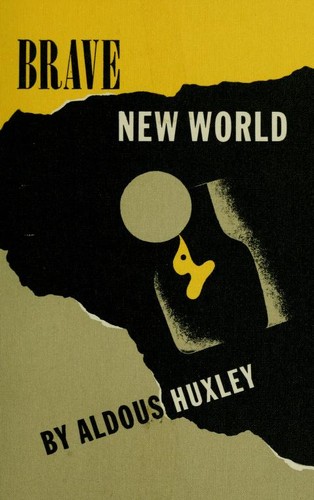
Brave New World
Aldous Huxley (1932)
“A world where everyone is happy, no one suffers, and something irreplaceable has been destroyed.”
Language Register
Formal-scientific in World State sections; archaic Shakespearean for John; journalistic irony throughout
Syntax Profile
World State narration: long, periodic sentences with scientific subordination — Huxley mimics the language of technical manuals and official reports. John's sections: shorter, rhythmically irregular, full of Shakespearean phrase-shapes and emotional ellipsis. Mond's dialogue: syntactically sophisticated, balanced clauses, ironic understatement.
Figurative Language
High in satirical passages; deliberately flat in administrative/conditioning descriptions. The horror of World State language is its absence of figurative language — when human experience is reduced to process, metaphor disappears.
Era-Specific Language
After Ford — the World State's calendar, replacing A.D. Ford is deity, his assembly line the sacred model
Government-issued pleasure drug; 'All the advantages of Christianity and alcohol; none of their defects'
World State highest erotic compliment — well-cushioned, physically pleasing. Lenina is repeatedly 'pneumatic'
The behaviorist process by which citizens' values and preferences are installed in infancy
Immersive cinema providing touch, smell, and emotion as well as sight — the World State's greatest artistic achievement
Human egg-budding that produces up to 96 identical embryos — mass production applied to people
World State term for birth — children are 'decanted' from bottles, not born from mothers
How Characters Speak — Class & Identity
Bernard Marx
Anxious, philosophically self-conscious, prone to grandiose claims that contradict his behavior. Uses World State vocabulary to complain about World State values — revealing how thoroughly conditioned even his rebellion is.
An Alpha who cannot transcend his conditioning even while resenting it. His critique of the system is genuine; his ability to act on it is nil. The World State produces exactly the kinds of dissidents it can neutralize.
Lenina Crowne
Present-tense, sensory, warm, entirely conditioned. Her language is rich in World State idiom ('everyone belongs to everyone else') and physical sensation. She rarely abstracts. She has no irony.
The World State's most successful product: genuinely content, genuinely kind, genuinely incapable of the experiences that would make her more. Her happiness is real; its costs are invisible to her.
John the Savage
Shakespearean cadences, archaic pronouns, formal vocatives ('thou,' 'thee,' 'dost'). Emotionally unguarded to a degree impossible for World State citizens. Biblical reference alongside Shakespeare. When in extremis, his sentences break and he speaks in pure quotation.
A man whose entire emotional vocabulary was formed by a single book. He is capable of enormous interior richness and incapable of any direct expression that isn't mediated by Shakespeare. His tragedy is that his language is too large for anyone in his world to hear.
Mustapha Mond
Polyglot, allusive, ironic. Quotes forbidden texts fluently. His sentences balance opposing positions with syntactic precision. He uses rhetorical questions to direct argument without appearing to push.
The most self-aware character in the novel — a man who chose to enforce a system he knows is a trade-off. His sophistication is the World State's ultimate justification of itself: even its most intelligent critic concluded the system was necessary.
Helmholtz Watson
Precise, economical, self-aware. He wastes fewer words than Bernard, qualifies his claims more honestly, and is more willing to admit uncertainty. His language has a controlled quality — as if he's always editing.
A man who knows how language works and is dissatisfied with what he's allowed to do with it. His linguistic precision is both his gift and his source of suffering: he is too good a writer to be satisfied with what the World State will let him write.
Narrator's Voice
Huxley narrates in omniscient third-person with a sardonic, essayistic intelligence — less character-bound than Fitzgerald's Nick, more willing to editorialize. The narration frequently adopts the World State's own language to describe World State practices, creating an ironic effect where horror is described in cheerful bureaucratic prose. The narrative distance decreases significantly in John's chapters, where Huxley allows genuine pathos.
Tone Progression
Chapters 1-3
Clinical, satirical, brightly horrifying
The World State presented in its own language — cheerful, efficient, pedagogical. The horror is in the gap between tone and content.
Chapters 4-9
Comic, melancholy, building dread
The human costs of the system emerge through Bernard's alienation, Helmholtz's creative frustration, and John's impossible formation.
Chapters 10-12
Satirical, socially sharp
Bernard's rise and fall, John's celebrity, the World State's immunity to genuine challenge.
Chapters 13-15
Painful, fragmented, violent
The collision of worlds — John/Lenina, John/Linda's death, the soma riot. The prose cracks under genuine emotion.
Chapters 16-18
Philosophical, elegiac, quietly devastating
The argument and the annihilation. Huxley strips away satire to allow tragedy its proper weight — then denies it a proper audience.
Stylistic Comparisons
- Nineteen Eighty-Four — Orwell's dystopia uses force; Huxley's uses pleasure. The comparison reveals which is more insidious.
- We by Yevgeny Zamyatin — the structural template both Huxley and Orwell drew from
- Point Counter Point — Huxley's own earlier novel, similarly concerned with the inadequacy of intelligence alone to provide meaning
Key Vocabulary from This Book
Notable words used in this text — click to see full definitions