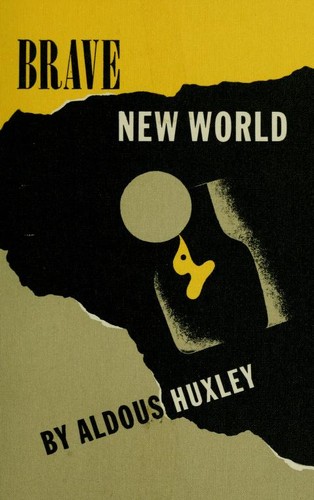
Brave New World
Aldous Huxley (1932)
“A world where everyone is happy, no one suffers, and something irreplaceable has been destroyed.”
Brave New World— Historical Context & Author Background
Author: Aldous Huxley · Published 1932· Era: Modernist / Dystopian·311 pages
Themes explored: technology, conformity, freedom, identity, class, happiness, nature, consumerism
About Aldous Huxley
Aldous Leonard Huxley (1894–1963) came from one of the most formidable intellectual dynasties in British history. His grandfather was T.H. Huxley, Charles Darwin's most combative defender and the coiner of the word 'agnostic.' His brother Julian became a leading biologist and UNESCO's first Director-General. His great-uncle was Matthew Arnold. The weight of Victorian scientific rationalism and literary distinction pressed on Huxley from birth — and his greatest novel is, among other things, a thought experiment about what happens when science wins completely. At sixteen, Huxley contracted keratitis punctata and was nearly blind for two to three years. He recovered partial sight, enough to read laboriously and write, but never well enough for his first ambition: medicine. He studied English at Balliol College, Oxford, instead, graduating in 1916 with a first-class degree. He spent years in London literary circles — he knew D.H. Lawrence, T.S. Eliot, Virginia Woolf — before settling in Italy and France in the 1920s. He moved to the United States in 1937, settling eventually in Los Angeles. He became close to the circle around the Vedanta Society and developed deep interests in mysticism, Eastern philosophy, and altered states of consciousness. In 1953, Huxley took mescaline for the first time, an experience he documented in The Doors of Perception (1954) — a book whose title came from William Blake and whose content directly influenced 1960s psychedelic culture. He experimented with LSD toward the end of his life and, on November 22, 1963 — the day John F. Kennedy was assassinated — died asking his wife to administer LSD to him as he lay dying. He died under its influence. The man who spent Brave New World satirizing pharmaceutical happiness spent his last hours seeking it through a different chemistry — a biographical irony he would have appreciated.
Life → Text Connections
How Aldous Huxley's real experiences shaped specific elements of Brave New World.
Huxley's grandfather T.H. Huxley was the Victorian era's greatest scientific polemicist, arguing that science would — and should — replace theology as civilization's organizing principle
The World State is T.H. Huxley's program taken to its logical endpoint — science in total control, religion abolished, human nature redesigned by engineering
Brave New World is partly a son's argument with his grandfather's intellectual legacy. The novel asks: what if you won? What does complete scientific control of human nature look like? The answer is Mustapha Mond's comfortable, devastating dystopia.
Huxley's near-blindness at sixteen removed him from the social world for years, making him an observer rather than a participant — forced to study human behavior from a slight remove
The novel's cold observational precision — its ability to describe the World State's rituals as if through glass, without moral editorializing in the prose itself
The narrative distance is biographical. Huxley learned to see clearly through partial vision. His prose never quite closes the gap between observer and observed.
Huxley's exposure to London literary modernism (Lawrence, Woolf, Eliot) and their shared anxiety about mass culture, popular entertainment, and the erosion of high art
The feelies — immersive cinema that replaces Shakespeare and renders art obsolete by making feeling effortless
Huxley was watching early cinema transform popular culture in the 1920s and extrapolated forward. The feely is his nightmare of what happens when art becomes entertainment and entertainment becomes pharmaceutical.
His later interest in mysticism, Vedanta, and eventually psychedelics — the search for transcendence outside conventional social structures
John's refusal of soma, his insistence on the right to suffer, his appeal to God and genuine experience
John's position is, in some ways, the position Huxley himself would later reach for — the insistence that consciousness has dimensions that cannot be produced by conditioning. The paradox is that Huxley reached for it through psychedelics, which soma's model anticipates.
Historical Era
Interwar Britain — 1920s-1930s, industrial modernity, mass culture, early totalitarianism
How the Era Shapes the Book
Huxley was writing in 1931, watching Soviet collectivism and German nationalism simultaneously, and reading utopian social scientists who believed human nature could be reshaped by the right institutional design. He took all of these impulses seriously — which is why the World State is such a rigorous extrapolation. It is not a caricature of one ideology but a synthesis of all the century's reforming ambitions: Pavlovian psychology, Fordist production, Wellsian social engineering, and Freudian pleasure-principle. The horror is that each individual element seemed, in 1931, like progress.
Why Brave New World Matters Historically
Published in 1932, it was immediately recognized as a significant work but did not achieve its current canonical status until after Nineteen Eighty-Four (1949) made dystopian fiction culturally central. The comparison with Orwell clarified what Huxley was doing: where Orwell feared totalitarianism through pain, Huxley feared it through pleasure. The two novels are now read together as complementary warnings — and many critics argue the twenty-first century has proved Huxley more prescient.
- First major dystopian novel to locate the horror in happiness rather than suffering — the 'soft' dystopia that uses pleasure as control
- First literary treatment of genetic engineering as social policy — Huxley anticipated CRISPR and designer embryos by six decades
- First sustained literary argument that the demand for stability and the demand for meaning are fundamentally incompatible
Banned and challenged extensively. Ireland banned it in 1932 on publication; India banned it in 1967 for its sexual content. Regularly challenged in American schools for 'insensitivity,' 'offensive language,' 'sexual content,' and — most revealingly — 'making promiscuous sex appear attractive and moral.' The challenges typically miss that the novel is satirizing the society they're defending.