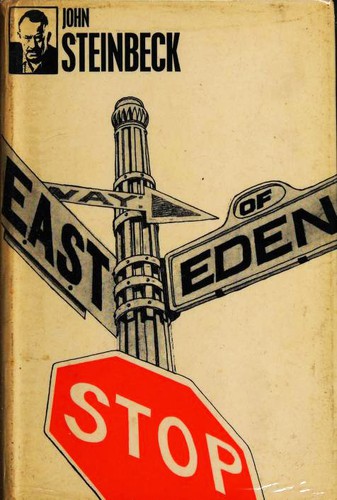
East of Eden
John Steinbeck (1952)
“Steinbeck's masterwork asks whether evil is inherited or chosen — and answers with a single Hebrew word that changes everything.”
At a Glance
Two families — the Trasks and the Hamiltons — are set against each other across generations in California's Salinas Valley, mirroring the biblical story of Cain and Abel. Adam Trask is deceived and destroyed by his wife Cathy, a near-mythic embodiment of evil, and their twin sons Cal and Aron replay the Cain-Abel cycle. The novel's philosophical core is 'timshel' — the Hebrew word meaning 'thou mayest' — suggesting that humans are not fated to sin or to goodness but are free to choose. Aron dies in WWI, Cal carries his guilt, and the dying Adam's final word to his son is 'timshel': the gift of free will.
Read full summary →Why This Book Matters
East of Eden was an immediate bestseller — unlike Gatsby, it succeeded in Steinbeck's lifetime, selling over 100,000 copies in its first year. Steinbeck considered it his masterwork and his legacy. The novel extended the American literary tradition of the family saga while anchoring it explicitly in biblical allegory — an ambition no other American novelist had attempted at this scale. It introduced 'timshel' as a cultural touchstone that has never fully faded.
Diction Profile
Shifts dramatically by section: lyrical and biblical in the Salinas Valley descriptions, essayistic in the timshel passages, clinical in the Cathy sections, colloquial in 1910s California dialogue
High but differently distributed than Fitzgerald. Steinbeck's metaphors are often extended over paragraphs rather than compressed into phrases. The Salinas Valley is metaphor, the geography is allegory, the names are allegory. But within individual scenes, the prose is often direct and plain