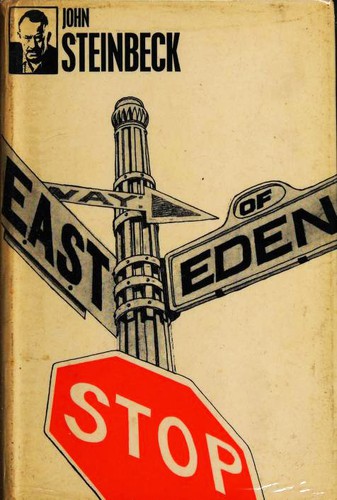
East of Eden
John Steinbeck (1952)
“Steinbeck's masterwork asks whether evil is inherited or chosen — and answers with a single Hebrew word that changes everything.”
Why This Book Matters
East of Eden was an immediate bestseller — unlike Gatsby, it succeeded in Steinbeck's lifetime, selling over 100,000 copies in its first year. Steinbeck considered it his masterwork and his legacy. The novel extended the American literary tradition of the family saga while anchoring it explicitly in biblical allegory — an ambition no other American novelist had attempted at this scale. It introduced 'timshel' as a cultural touchstone that has never fully faded.
Firsts & Innovations
The first major American novel to explicitly argue free will against Calvinist predestination through biblical textual analysis
One of the first American bestsellers to give a non-white character (Lee) the novel's central philosophical role
The most sustained attempt in American fiction to update a biblical story (Cain and Abel) as a realistic family saga
Cultural Impact
James Dean's final film adaptation (1955) — Cal Trask was Dean's defining role and shaped a generation's understanding of the 'bad son' archetype
The word 'timshel' has entered philosophical and theological discourse as shorthand for the free-will argument against predestination
Steinbeck won the Nobel Prize in Literature in 1962; East of Eden was central to the citation
The novel is a perennial AP English Literature free-response novel — consistently among the top ten most cited titles
Taylor Swift named her album 'The Tortured Poets Department' — but the Cain-Abel dynamic Cal-and-Aron created has influenced countless stories about siblings and unwanted darkness
Banned & Challenged
Challenged in schools primarily for sexual content (Cathy/Kate's prostitution, the brothel scenes) and for what some boards have called 'moral ambiguity that normalizes sin.' The irony is acute: the novel's entire argument is that sin must be named clearly before it can be chosen against.