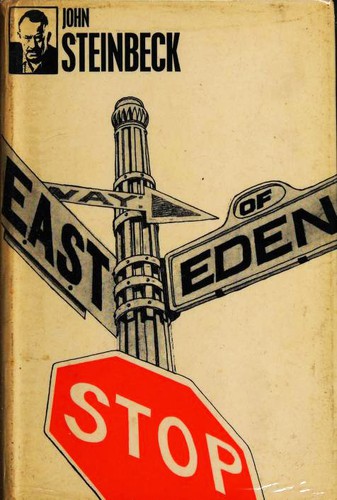
East of Eden
John Steinbeck (1952)
“Steinbeck's masterwork asks whether evil is inherited or chosen — and answers with a single Hebrew word that changes everything.”
Essay Questions & Food for Thought
30questions designed to challenge assumptions and provoke original thinking. These can't be answered from a summary — you need the actual text.
Steinbeck argues that 'timshel' — 'thou mayest' — is 'the most important word in the world.' Do you agree? What would change about the novel's meaning if the Hebrew actually meant 'thou shalt'?
Cathy is described as a 'monster' born without normal human empathy. Does her existence undermine the novel's free-will thesis? Can 'timshel' apply to someone incapable of choosing good?
Both the Trask and Hamilton families lose sons — Charles to isolation, Tom to suicide, Aron to war. What does Steinbeck suggest about the cost of being the 'wrong kind' of sensitive in America?
Lee speaks pidgin English for years as a deliberate performance. How does this relate to the novel's larger theme of chosen identity versus inherited identity?
Why does Cal's father reject his gift of $15,000? Is Adam right to refuse? Is the rejection the same as God's rejection of Cain's offering in Genesis?
Steinbeck explicitly tells us he is going to discuss the Cain-Abel story and its meaning. Why does naming the allegory not make it less powerful? What is lost and gained by being so direct?
Cal takes Aron to meet their mother as revenge. Is he acting as Cain in this moment, or as something more complicated? Does intent matter if the outcome is the same?
Adam Trask is a 'good' person who causes enormous damage to everyone around him — through his blindness, his idealism, his inability to see clearly. Is passivity a form of evil?
The novel covers roughly 1860–1918. What is Steinbeck saying by ending in WWI rather than at a moment of peace or prosperity?
Steinbeck says the Salinas Valley was 'east of Eden' — the region of exile where Cain was sent after the murder. Is this a pessimistic framing? Does the novel end in exile or in something else?
Compare Charles Trask and Cal Trask as first- and second-generation Cain figures. What does Steinbeck suggest changes — or doesn't — across a generation?
Abra gradually recognizes that Aron loves an idea of her rather than her actual self. How does this mirror the Gatsby-Daisy dynamic? What does both novels suggest about idealization and love?
Steinbeck intrudes on the narrative repeatedly as himself — 'I believe,' 'I think,' 'let me tell you.' What is the effect of this? Does the author's presence strengthen or weaken the novel's credibility?
Kate's will leaves everything to Aron — an act meant to destroy him through contamination. Why does Steinbeck allow her this moment of apparent maternal acknowledgment? Does it humanize her?
Lee has spent his entire adult life performing a false identity to protect himself from white racism. Is this a form of the Cain exile — punished for something he didn't choose — or is it timshel — a choice freely made?
Samuel Hamilton dies before the final crisis, removing the novel's moral compass just when it's most needed. Why does Steinbeck structure the novel this way?
Steinbeck says he wrote the book partly to explain the world to his sons. How does knowing this change your reading of Cal — the son who receives 'timshel' at the end?
The novel spans over fifty years. What does Steinbeck gain by covering so much time? What does he risk by not staying close to a single character throughout?
Compare Adam's failure as a father to Cyrus Trask's — and to the biblical God's treatment of Cain. Is favoritism a kind of original sin that the novel argues every generation repeats?
The novel's landscape — the Salinas Valley — is described at the start as both light and dark, inviting and threatening. How does the geography function as a moral argument throughout the novel?
Is East of Eden an optimistic novel or a tragic one? The Cain-Abel pattern repeats across two generations, ending in death and stroke. But the final word is 'timshel.' How do you read that ending?
Steinbeck was criticized by some reviewers for making Cathy too unrealistic — a symbol rather than a person. Do you agree? Is it possible to write a character who represents pure evil and also be a good novelist?
The James Dean film (1955) shows only the last third of the novel — Cal, Aron, and the deathbed. What is lost by removing the Hamilton story and the timshel conversation from the adaptation?
Lee says 'timshel' might be 'the most important word in the world.' Lee is also a man who has been denied basic dignity by the society around him. What does it mean for that man to argue for the freedom of human choice?
Compare Steinbeck's East of Eden to Dostoevsky's The Brothers Karamazov. Both are multi-generational family sagas structured around competing moral philosophies. What can each novel do that the other cannot?
Cyrus Trask invented a heroic war record he never earned and built power from that lie. How is this a first-generation version of the American Dream, and how does it set up the Trask family's later tragedies?
Abra Bacon says to Cal: 'He doesn't see me. He sees something he made up.' How does this apply to Adam's relationship with Cathy and with Cal? Is the Trask men's inability to see clearly hereditary or chosen?
The novel was written partly as a response to the Korean War and the early Cold War — an era when American culture was obsessed with loyalty, patriotism, and the containment of evil. How does 'timshel' function as a political as well as a personal argument in that context?
Choose any two characters from different generations and argue for their connection. How does Steinbeck use family resemblance — physical, psychological, or moral — to extend the Cain-Abel pattern across time?
Adam's last word is 'timshel.' If you could give Cal one final word as he leaves his father's deathbed, what would it be — and why? What does the novel's ending suggest Cal will do with the word he's been given?