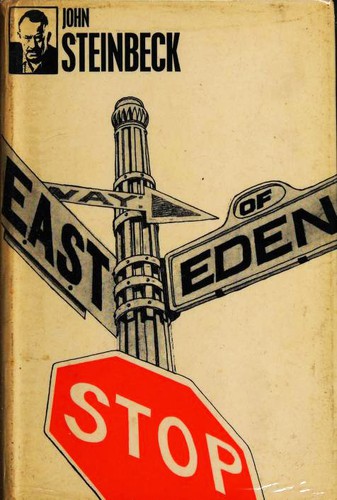
East of Eden
John Steinbeck (1952)
“Steinbeck's masterwork asks whether evil is inherited or chosen — and answers with a single Hebrew word that changes everything.”
East of Eden— Summary & Analysis
by John Steinbeck · published 1952 · 601 pages · Modernist / Mid-Century American
A user-friendly study guide for East of Eden by John Steinbeck (1952): a high-level plot summary, full chapter-by-chapter analysis, theme breakdowns, character profiles, and 30 essay questions designed for ap-english, college readers. Unlike a stock summary, sumsumsum.com adds a diction analysis drawn from John Steinbeck’s actual text, the 9 documented AP Literature exam appearances of this book, and reading-difficulty guidance (Easy, 3/10) so students, teachers, and lifelong readers know what they are walking into.
“Steinbeck's masterwork asks whether evil is inherited or chosen — and answers with a single Hebrew word that changes everything.”
Short Summary
Two families — the Trasks and the Hamiltons — are set against each other across generations in California's Salinas Valley, mirroring the biblical story of Cain and Abel. Adam Trask is deceived and destroyed by his wife Cathy, a near-mythic embodiment of evil, and their twin sons Cal and Aron replay the Cain-Abel cycle. The novel's philosophical core is 'timshel' — the Hebrew word meaning 'thou mayest' — suggesting that humans are not fated to sin or to goodness but are free to choose. Aron dies in WWI, Cal carries his guilt, and the dying Adam's final word to his son is 'timshel': the gift of free will.
Detailed Summary
East of Eden opens with a rhapsodic description of the Salinas Valley in California, which Steinbeck treats as a character and an Eden in its own right — fertile and beautiful, shadowed by the dark Santa Lucia mountains to the west. The Hamilton family arrives first. Samuel Hamilton, Irish immigran...
Summary in the Author’s Writing Style
A retelling of East of Eden in John Steinbeck’s style — so you can hear the language, not just the plot. This is a stylistic pastiche written by sumsumsum, not an excerpt from the book.
I want to tell you about a valley, because the valley is where it starts. The Salinas lay long and open between two ranges, the Gabilans to the east all sunlight and invitation, and the Santa Lucias to the west dark and brooding, holding back the sea and the dusk. The good earth there could grow any…
Chapter-by-Chapter Analysis
If you liked East of Eden, read next
Start with The Brothers Karamazov by Fyodor Dostoevsky — The closest analogue in world literature: multi-generational family saga structured around competing moral philosophies, with a wise mentor figure (Zosima/Samuel) and a dark-and-light sibling pair. Then try One Hundred Years of Solitude by Gabriel García Márquez — The family-saga-as-myth form, tracking a family across generations with recurring names and fates. Márquez is more fatalistic; Steinbeck inserts timshel as the break in the cycle.. Or pivot to Blood Meridian by Cormac McCarthy — McCarthy's Judge Holden is the answer to the question Steinbeck asked about Cathy: what does absolute evil look like when taken seriously? A much darker answer than Steinbeck's..
For comparative essays, pair East of Eden with
The strongest comparative pairing is The Great Gatsby (F. Scott Fitzgerald) — Both are American myths — Fitzgerald's is vertical (class and the Dream), Steinbeck's is horizontal (family and the land). The green light and timshel are different answers to the same American question.. For a third angle, contrast with Beloved (Toni Morrison) — Both novels argue that inherited trauma is real but not destiny. Morrison's characters carry slavery's wound; Steinbeck's carry the Cain pattern. Both insist the story can be told otherwise..
Each of these pairings opens a clean thesis path on shared themes, period diction, or formal influence — useful for AP Lit / IB / first-year college comparative essays.
More from John Steinbeck and the scholars who study Steinbeck
Other works by John Steinbeck: Of Mice and Men (1937, 112 pages), The Grapes of Wrath (1939, 464 pages), The Pearl (1947, 96 pages). Reading two or three of these in sequence reveals John Steinbeck’s recurring obsessions and stylistic signatures more clearly than any single book can.