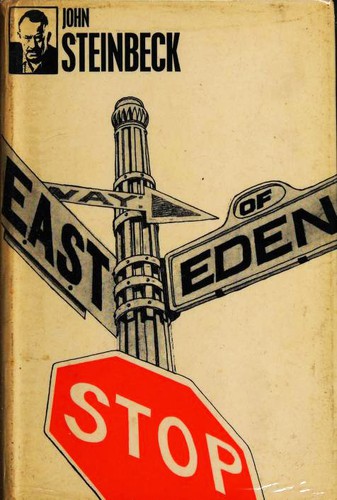
East of Eden
John Steinbeck (1952)
“Steinbeck's masterwork asks whether evil is inherited or chosen — and answers with a single Hebrew word that changes everything.”
East of Eden— Historical Context & Author Background
Author: John Steinbeck · Published 1952· Era: Modernist / Mid-Century American·601 pages
Themes explored: good-vs-evil, free-will, family, legacy, identity, sin, redemption
About John Steinbeck
John Steinbeck (1902–1968) was born in Salinas, California — the exact valley of the novel. The Hamiltons are his mother's family, and Samuel Hamilton is based on his grandfather Samuel Hamilton, an Irish immigrant who farmed near King City. Steinbeck spent years researching the novel, including studying Hebrew to verify the 'timshel' translation. He called East of Eden 'the big book' and 'everything I have to say.' The novel was written partly as a gift to his sons Tom and John — a letter explaining the world they were inheriting. He won the Nobel Prize in Literature in 1962, ten years after its publication, and East of Eden was cited as a central work.
Life → Text Connections
How John Steinbeck's real experiences shaped specific elements of East of Eden.
Steinbeck grew up in the Salinas Valley — the novel's physical landscape is his childhood
The valley description opening the novel is personal memory elevated to myth
The emotional weight of the landscape comes from actual love for a place. Steinbeck is not inventing an Eden — he is naming one he knew.
His mother's family were the Hamiltons — Samuel Hamilton is his grandfather
Samuel Hamilton, the moral center, is autobiographical in origin
The warmth, the wisdom, and the tragedy of the Hamilton sections come from a grandson's memory of a man he revered.
Steinbeck wrote the novel as an explicit letter to his sons, to explain the world they were inheriting
The novel's directly addressed narrator ('I believe,' 'let me tell you') — he is speaking to his sons throughout
The book's unusual first-person essayistic intrusions are not stylistic experiments — they are a father talking to his children.
He spent years studying Hebrew to verify 'timshel,' consulting scholars and checking multiple translations
Lee's speech about the Hebrew scholars in San Francisco mirrors Steinbeck's own research process
The timshel argument is not a literary device but a genuine conviction — Steinbeck believed this word changed the meaning of Western ethics.
Historical Era
1860s–1918 (with retrospective narration from post-WWII America)
How the Era Shapes the Book
WWI functions as the novel's apocalypse — the war that devours the innocent (Aron) and leaves the complicated alive (Cal). Steinbeck wrote the novel in the early 1950s, looking back at WWI through the lens of WWII and Korea, and the sense of cyclical historical catastrophe deepens the Cain-Abel framework. The Chinese Exclusion Act and California's documented anti-Chinese racism make Lee's performance not merely a character choice but a historical survival strategy.
Why East of Eden Matters Historically
East of Eden was an immediate bestseller — unlike Gatsby, it succeeded in Steinbeck's lifetime, selling over 100,000 copies in its first year. Steinbeck considered it his masterwork and his legacy. The novel extended the American literary tradition of the family saga while anchoring it explicitly in biblical allegory — an ambition no other American novelist had attempted at this scale. It introduced 'timshel' as a cultural touchstone that has never fully faded.
- The first major American novel to explicitly argue free will against Calvinist predestination through biblical textual analysis
- One of the first American bestsellers to give a non-white character (Lee) the novel's central philosophical role
- The most sustained attempt in American fiction to update a biblical story (Cain and Abel) as a realistic family saga
Challenged in schools primarily for sexual content (Cathy/Kate's prostitution, the brothel scenes) and for what some boards have called 'moral ambiguity that normalizes sin.' The irony is acute: the novel's entire argument is that sin must be named clearly before it can be chosen against.