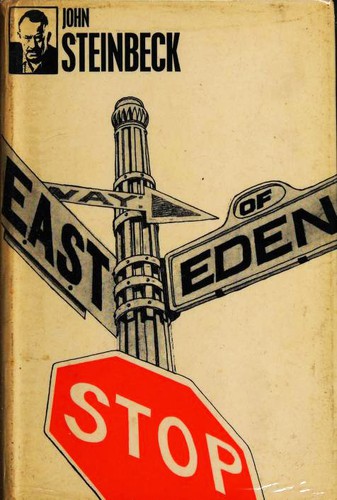
East of Eden
John Steinbeck (1952)
“Steinbeck's masterwork asks whether evil is inherited or chosen — and answers with a single Hebrew word that changes everything.”
This page prints on a single page. Use Ctrl+P / Cmd+P.
East of Eden
John Steinbeck (1952) · 601pages · Modernist / Mid-Century American · 9 AP appearances
Summary
Two families — the Trasks and the Hamiltons — are set against each other across generations in California's Salinas Valley, mirroring the biblical story of Cain and Abel. Adam Trask is deceived and destroyed by his wife Cathy, a near-mythic embodiment of evil, and their twin sons Cal and Aron replay the Cain-Abel cycle. The novel's philosophical core is 'timshel' — the Hebrew word meaning 'thou mayest' — suggesting that humans are not fated to sin or to goodness but are free to choose. Aron dies in WWI, Cal carries his guilt, and the dying Adam's final word to his son is 'timshel': the gift of free will.
Why It Matters
East of Eden was an immediate bestseller — unlike Gatsby, it succeeded in Steinbeck's lifetime, selling over 100,000 copies in its first year. Steinbeck considered it his masterwork and his legacy. The novel extended the American literary tradition of the family saga while anchoring it explicitly...
Themes & Motifs
Diction & Style
Register: Shifts dramatically by section: lyrical and biblical in the Salinas Valley descriptions, essayistic in the timshel passages, clinical in the Cathy sections, colloquial in 1910s California dialogue
Narrator: Steinbeck himself intrudes frequently into the narration — not as a character but as the storyteller, saying 'I belie...
Figurative Language: High but differently distributed than Fitzgerald. Steinbeck's metaphors are often extended over paragraphs rather than compressed into phrases. The Salinas Valley is metaphor, the geography is allegory, the names are allegory. But within individual scenes, the prose is often direct and plain
Historical Context
1860s–1918 (with retrospective narration from post-WWII America): WWI functions as the novel's apocalypse — the war that devours the innocent (Aron) and leaves the complicated alive (Cal). Steinbeck wrote the novel in the early 1950s, looking back at WWI through ...
Key Characters
Talking Points
- Steinbeck argues that 'timshel' — 'thou mayest' — is 'the most important word in the world.' Do you agree? What would change about the novel's meaning if the Hebrew actually meant 'thou shalt'?
- Cathy is described as a 'monster' born without normal human empathy. Does her existence undermine the novel's free-will thesis? Can 'timshel' apply to someone incapable of choosing good?
- Both the Trask and Hamilton families lose sons — Charles to isolation, Tom to suicide, Aron to war. What does Steinbeck suggest about the cost of being the 'wrong kind' of sensitive in America?
- Lee speaks pidgin English for years as a deliberate performance. How does this relate to the novel's larger theme of chosen identity versus inherited identity?
- Why does Cal's father reject his gift of $15,000? Is Adam right to refuse? Is the rejection the same as God's rejection of Cain's offering in Genesis?
Notable Quotes
“I remember that the Gabilan Mountains to the east of the valley were light gay mountains full of sun and loveliness and a kind of invitation, so th...”
“I believe there are monsters born in the world to human parents. Some you can see, misshapen and horrible, with huge heads or tiny bodies. And just...”
“I believe that there is one story in the world, and only one... Humans are caught — in their lives, in their thoughts, in their hungers and ambitio...”
Why Read This
Because the question the novel asks — are you defined by your worst impulse or by what you do next? — is the most important question a person can face at seventeen. And because 'timshel' is a more useful framework than anything you will find on so...