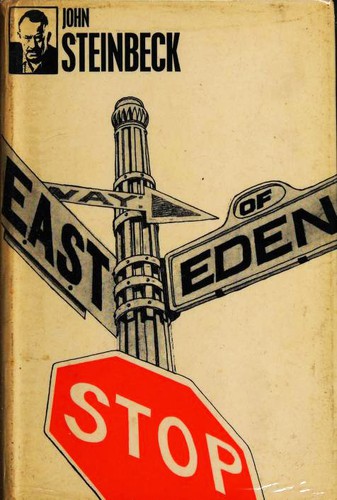
East of Eden
John Steinbeck (1952)
“Steinbeck's masterwork asks whether evil is inherited or chosen — and answers with a single Hebrew word that changes everything.”
Language Register
Shifts dramatically by section: lyrical and biblical in the Salinas Valley descriptions, essayistic in the timshel passages, clinical in the Cathy sections, colloquial in 1910s California dialogue
Syntax Profile
Steinbeck's sentences are more varied than Fitzgerald's and more controlled than Faulkner's. The narration shifts between rhapsodic long sentences (the valley descriptions), essay-length meditations (the timshel passages), and telegraphic short sentences (moments of violence or revelation). The variation is itself expressive — the prose knows when to slow down and when to strike.
Figurative Language
High but differently distributed than Fitzgerald. Steinbeck's metaphors are often extended over paragraphs rather than compressed into phrases. The Salinas Valley is metaphor, the geography is allegory, the names are allegory. But within individual scenes, the prose is often direct and plain — the figurative meaning lives in the structure, not the decoration.
Era-Specific Language
Hebrew for 'thou mayest' — the novel's single-word thesis, asserting free will over determinism
N/A — but compare to Gatsby: East of Eden has no such affectation because its characters do not perform class
The generational inheritance of jealousy, favoritism, and the rejected offering — made explicit by Steinbeck himself
Charles Trask's forehead scar — Steinbeck's direct visual echo of the mark of Cain
Steinbeck's autobiographical California landscape, treated as a character and a moral landscape simultaneously
How Characters Speak — Class & Identity
Samuel Hamilton
Warm, digressive, full of Irish storytelling rhythm. Long sentences that double back on themselves. Humor as philosophy.
A man comfortable with ambiguity — his speech never forces conclusions but opens possibilities.
Lee
Two voices: pidgin (strategic, protective) and true voice (the richest, most literary in the novel). The switch between them is always deliberate.
Intelligence that has learned to be invisible in order to survive — and the cost of that invisibility over a lifetime.
Cathy/Kate
Minimal, precise, without warmth. She speaks only enough to get what she wants. Never an unnecessary word.
Language as a tool of manipulation. She is constitutionally incapable of conversation — only of transaction.
Cal Trask
Direct, vulnerable, occasionally brutal. He says what he means when it matters — the opposite of his father's evasions.
The dark son who sees clearly. His honesty is not virtue — it is the result of having nothing to protect.
Adam Trask
Idealistic, slow, inclined to abstraction. His language delays confrontation and aestheticizes reality.
A good man with a fatal inability to see. His language is always a little behind events.
Narrator's Voice
Steinbeck himself intrudes frequently into the narration — not as a character but as the storyteller, saying 'I believe' and 'I think' and 'Let me tell you about.' This first-person essayistic intrusion is unusual in American fiction and sometimes controversial. It makes the novel feel like Steinbeck is sitting across from you, telling you the most important story he knows.
Tone Progression
Part One (Chapters 1–11)
Rhapsodic, establishing, ominous
The valley is described with love; the Hamiltons with warmth; Cathy with cold dread. Three tones in eleven chapters.
Part Two (Chapters 12–29)
Philosophical, elegiac, revelatory
The timshel conversation anchors this section. Samuel's death ends it. The prose is at its most meditation-heavy.
Part Three (Chapters 30–46)
Intimate, adolescent, tightening
The coming-of-age section. Shorter sentences, closer to the boys' interiority. The allegory becomes personal.
Part Four (Chapters 47–End)
Tragic, compressed, quietly transcendent
Events accelerate. Sentences shorten. The novel races toward its last word and then delivers it in a whisper.
Stylistic Comparisons
- The Bible (Genesis specifically) — the structural and tonal ur-text for the entire novel
- Faulkner's The Sound and the Fury — family saga across generations, but Steinbeck is clearer, more direct, less deliberately chaotic
- Dostoevsky's The Brothers Karamazov — the closest comparison: generational family tragedy structured around competing moral philosophies
- Fitzgerald's The Great Gatsby — both are American myths, but Steinbeck's is biblical and horizontal (family/land) where Fitzgerald's is vertical (class/dream)
Key Vocabulary from This Book
Notable words used in this text — click to see full definitions