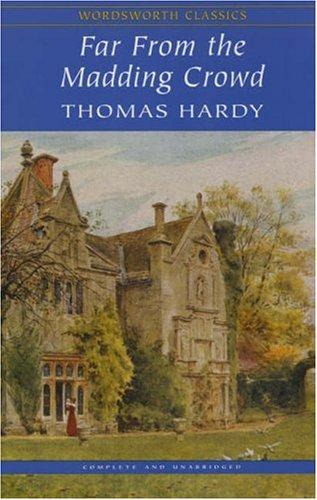
Far from the Madding Crowd
Thomas Hardy (1874)
“Three men love one woman in Hardy's Wessex — and each offers a different vision of what love demands, destroys, and endures.”
Characters in Far from the Madding Crowd
by Thomas Hardy · 1874 · 6 characters analyzed
Cast: Bathsheba Everdene, Gabriel Oak, Sergeant Francis Troy, William Boldwood, Fanny Robin, Liddy Smallbury.
Character Analysis
One of Victorian literature's great independent women — beautiful, vain, capable, and ultimately resilient. Bathsheba manages a farm, refuses proposals, makes catastrophic romantic choices, and survives them all. Her journey from vanity to wisdom is Hardy's central achievement: she is not tamed but educated, and the education comes through suffering rather than submission. She marries Oak at the end not because she has been broken but because she has finally learned to value substance over spectacle.
Educated, confident, increasingly measured — her speech matures from impulsive declarations to considered statements as the novel progresses.
The novel's embodiment of patient, selfless love. Oak proposes early, is refused, and then spends the rest of the novel simply being useful — saving sheep, saving harvests, saving Bathsheba from the consequences of her choices. His constancy is not passivity but the deepest form of devotion: he loves Bathsheba by serving her interests without demanding reciprocity. Hardy names him 'Oak' deliberately — strong, slow-growing, enduring.
Plain, direct, sparing — Oak says what he means without embellishment and rarely speaks unless he has something necessary to say.
The dangerous suitor — passionate, reckless, sexually magnetic, and fundamentally shallow. Troy's love is performance: dazzling in the moment, worthless in the morning. His sword-exercise seduction of Bathsheba is one of Victorian literature's most erotic scenes, but his treatment of both Bathsheba and Fanny Robin reveals a man incapable of sustained commitment. He loves the dead Fanny more than the living Bathsheba because the dead make no demands.
A prosperous, emotionally repressed gentleman farmer destroyed by a valentine he was never meant to receive. Boldwood's love for Bathsheba is obsessive, consuming, and ultimately murderous — not because he is evil but because a lifetime of emotional suppression left him with no capacity to regulate feeling once it was awakened. Hardy treats him as a clinical study in the psychology of obsession, deserving pity more than condemnation.
Formal, stilted, repetitive — Boldwood circles back to the same requests and declarations, unable to find new language for his obsession.
The novel's most pathetic figure — a young woman seduced and abandoned by Troy, who dies in a workhouse giving birth to his stillborn child. Fanny never speaks in her own defense; Hardy gives her suffering without voice, which makes the suffering more, not less, devastating. Her coffin, brought to Bathsheba's house, becomes the instrument of truth that destroys the Troy marriage.
Bathsheba's maid and closest friend, who serves as sounding board, accomplice, and comic relief. Liddy suggests sending the valentine to Boldwood — making her a minor catalyst for major tragedy. She represents the female companionship that sustains Bathsheba through her worst periods and provides Hardy with a means to externalize Bathsheba's internal debates.