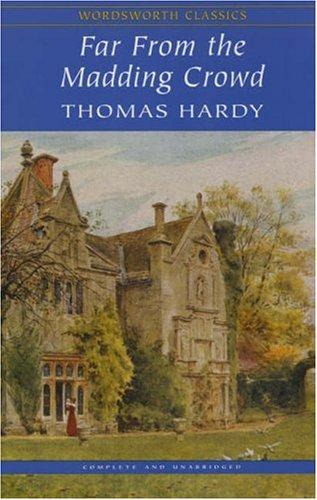
Far from the Madding Crowd
Thomas Hardy (1874)
“Three men love one woman in Hardy's Wessex — and each offers a different vision of what love demands, destroys, and endures.”
Far from the Madding Crowd— Historical Context & Author Background
Author: Thomas Hardy · Published 1874· Era: Victorian·416 pages
Themes explored: love, independence, pastoral, fate, patience, vanity, class, nature
About Thomas Hardy
Thomas Hardy (1840-1928) was born in Higher Bockhampton, Dorset — the heart of the Wessex he would invent. The son of a stonemason, Hardy trained as an architect before turning to fiction. Far from the Madding Crowd (1874) was his first major success, serialized in the prestigious Cornhill Magazine. He married Emma Gifford the same year, a relationship that would sour into decades of unhappiness before her death in 1912 inspired some of his greatest poetry. Hardy's deep knowledge of rural Dorset — its farming practices, its dialect, its social hierarchies, its relationship to the land — informs every page of the novel. He would go on to write increasingly dark fiction (The Return of the Native, The Mayor of Casterbridge, Tess of the d'Urbervilles, Jude the Obscure) before abandoning novels entirely after the hostile reception of Jude in 1895, devoting his remaining three decades to poetry.
Life → Text Connections
How Thomas Hardy's real experiences shaped specific elements of Far from the Madding Crowd.
Hardy grew up in rural Dorset among agricultural laborers and knew their work, dialect, and social world intimately
The Weatherbury farmworkers — their dialect, their communal wisdom, their relationship to the land — are drawn from direct observation, not literary convention
Hardy's pastoral is authentic because it is autobiographical. The farmworkers are not stage peasants but real people whose speech patterns Hardy heard as a child.
Hardy married Emma Gifford in 1874, the same year the novel was published — a marriage that began in romance and ended in estrangement
The novel's anatomy of romantic love — its varieties, its illusions, its capacity to both elevate and destroy — reflects Hardy's own ambivalent relationship with marriage
Hardy wrote the novel's celebration of patient, companionate love while entering a marriage that would teach him its opposite.
Hardy trained as an architect and brought a structural sensibility to fiction — designing plots with the precision of buildings
The novel's architecture is meticulous: three suitors as three modes of love, the valentine as structural hinge, the storm scene as central set piece
Hardy's architectural training explains the novel's structural clarity — every scene bears weight, every detail supports the whole.
Hardy was deeply influenced by Darwin's On the Origin of Species (1859) and its implications for human meaning in an indifferent universe
The natural world in the novel is beautiful but indifferent — the cliff that kills Oak's sheep, the storm that threatens the harvest, the gargoyle that destroys Troy's flowers
Hardy's post-Darwinian landscape refuses the Victorian idea that nature is morally ordered. Things happen because they happen, not because anyone deserves them.
Historical Era
1870s rural England — agricultural depression, shifting class structures, emerging feminism
How the Era Shapes the Book
Bathsheba's independence as a female farm owner was legally precarious in the 1870s — married women could not own property independently. Her refusal to marry is not merely romantic preference but economic self-preservation. Hardy's Wessex captures a rural world under threat from modernization, and the novel's pastoral rhythms have an elegiac quality — this way of life was already disappearing when Hardy wrote about it.
Why Far from the Madding Crowd Matters Historically
Far from the Madding Crowd was Hardy's breakthrough — the novel that established him as a major Victorian writer and invented Wessex as a literary landscape. Serialized in the Cornhill Magazine (edited by Leslie Stephen, Virginia Woolf's father), it reached a wide audience and demonstrated that rural life could sustain serious literary fiction. Bathsheba Everdene remains one of English literature's great female characters — independent, flawed, resilient, and permitted to grow. The novel pioneered the integration of landscape and psychology that would define Hardy's subsequent masterpieces.
- First appearance of Hardy's Wessex — the fictional county that became one of literature's most fully realized imaginary geographies
- One of the earliest Victorian novels to center a woman who runs a business, refuses marriage, and is not punished for her independence
- Pioneered the sustained integration of agricultural landscape with psychological narrative in English fiction
Not banned, but censored during serialization — Leslie Stephen required Hardy to remove the detail of Fanny Robin's baby from the magazine version, fearing it was too explicit. Hardy restored it for the book edition. The episode foreshadowed the more severe censorship battles Hardy would face with Tess and Jude.