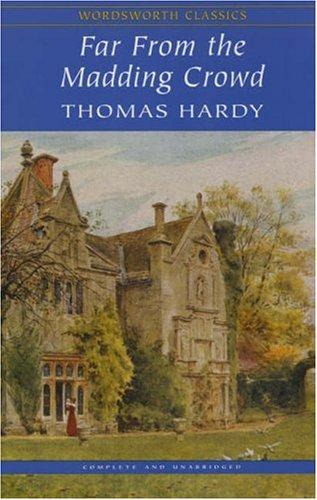
Far from the Madding Crowd
Thomas Hardy (1874)
“Three men love one woman in Hardy's Wessex — and each offers a different vision of what love demands, destroys, and endures.”
Essay Questions & Food for Thought
30questions designed to challenge assumptions and provoke original thinking. These can't be answered from a summary — you need the actual text.
Hardy presents three suitors for Bathsheba — Oak (steady), Boldwood (obsessive), Troy (passionate). Which does the novel argue is the 'right' kind of love, and what evidence supports your reading?
Bathsheba sends the valentine on impulse. Is Hardy suggesting that small, thoughtless acts can cause as much destruction as deliberate malice? Find three consequences of the valentine.
The sword-exercise scene is often called the most erotic passage in Victorian literature. How does Hardy convey sexual tension without explicit content? What literary techniques does he use?
Why does Hardy name his protagonist 'Oak'? How does the name function as characterization, and what does it tell us about Hardy's values?
Fanny Robin's baby was censored from the magazine serialization. Why would a Victorian editor find the baby more objectionable than Fanny's death? What does restoring it add to the novel?
How does the storm scene function as a test of character? What does each character's behavior during the storm reveal about their fitness as Bathsheba's partner?
Hardy's narrator says Bathsheba is 'of the stuff of which great men's mothers are made.' Is this a compliment, a limitation, or both? What does it reveal about Victorian assumptions regarding female worth?
Compare the gargoyle that destroys Troy's flowers on Fanny's grave to the cliff that kills Oak's sheep. What do these moments tell us about Hardy's view of nature and fate?
Is Bathsheba a feminist character? She runs a farm, refuses marriage, and defies convention — but she also marries twice and makes choices driven by vanity. How would a modern feminist critic read her?
Boldwood buys jewelry labeled 'Donum Boldwood' — 'gift of Boldwood.' What does this Latin inscription reveal about how Boldwood understands love?
Troy tells Bathsheba that dead Fanny was 'more to me... than ever you were, or are, or can be.' Is he telling the truth? Does Troy love Fanny, or does he love the idea of Fanny?
Hardy called Wessex a 'partly real, partly dream' landscape. How does the novel's setting function as more than backdrop? Find three moments where landscape shapes or mirrors character.
The novel's title comes from Thomas Gray's 'Elegy Written in a Country Churchyard': 'Far from the madding crowd's ignoble strife.' How does this epigraph shape your reading of Hardy's pastoral world?
Bathsheba opens Fanny's coffin knowing what she might find inside. Why does she do it? What does this act of confrontation reveal about her character?
The farmworkers (Poorgrass, Coggan, Tall) provide comic commentary throughout the novel. What is their structural function? Why does Hardy give them the final word on the marriage?
How does Hardy use the seasons structurally? Map the major events to their seasons and explain what the seasonal cycle adds to the novel's meaning.
Compare Boldwood's shooting of Troy to a crime of passion defense. Does Hardy present Boldwood as morally responsible, legally responsible, both, or neither?
Bathsheba and Oak's proposal scene is deliberately anti-romantic — awkward, indirect, full of pauses. Why does Hardy make it this way? What is he saying about the relationship between genuine love and eloquent expression?
Hardy was influenced by Darwin. How does a Darwinian worldview — nature as indifferent process, survival as the highest achievement — inform the novel's treatment of love and loss?
The novel was serialized in monthly installments. How might the serial format have shaped Hardy's plotting — particularly the cliffhangers, the pacing, and the valentine's placement?
Compare Bathsheba Everdene to Jane Eyre. Both are independent women in rural England who resist conventional marriage. How do their journeys differ, and what do those differences reveal about Hardy versus Charlotte Bronte?
Troy plants flowers on Fanny's grave, and the gargoyle washes them away. He does not replant. Oak would have replanted. What does this single detail tell us about the difference between the two men?
Bathsheba's valentine to Boldwood is often compared to a careless text or social media message today. What does the valentine reveal about the power of communication when the sender doesn't consider the receiver?
Why does Hardy not give Fanny Robin a voice? She is one of the novel's most important characters, yet she barely speaks. Is this a failure of Hardy's imagination or a deliberate artistic choice?
The novel ends with marriage, which is a conventional comic ending. But Hardy has shown us that marriage can be destructive (Troy), obsessive (Boldwood), and suffocating. How does he earn a happy ending after demonstrating marriage's dangers?
Hardy describes Bathsheba looking at herself in a mirror in the novel's opening scene. What does this image establish about her character, and how does it relate to her final scene with Oak?
How does Hardy's background as a trained architect influence the novel's structure? Identify three architectural principles (symmetry, load-bearing elements, planned sight lines) that operate in the plot.
Bathsheba fires Oak for telling her the truth about Troy, then immediately rehires him to save her sick sheep. What does this pattern — reject counsel, face crisis, need Oak — reveal about the dynamics of their relationship?
If the novel were set in 2026, what would the valentine be — a DM? A like on Instagram? A swipe right? How would the medium change the moral dynamics of careless communication?
Hardy's later novels (Tess, Jude) are far bleaker — their protagonists are destroyed by the systems they live in. Far from the Madding Crowd allows a happy ending. What changed in Hardy's worldview between 1874 and 1895, and does the happy ending weaken or strengthen this novel?