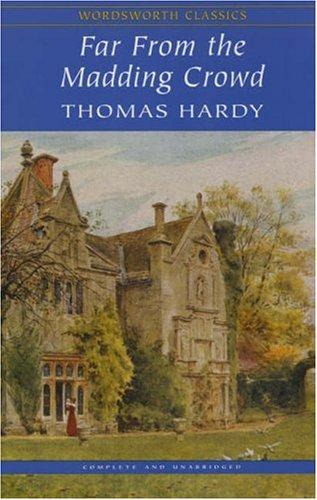
Far from the Madding Crowd
Thomas Hardy (1874)
“Three men love one woman in Hardy's Wessex — and each offers a different vision of what love demands, destroys, and endures.”
Language Register
Elevated Victorian prose mixed with Wessex dialect in dialogue — the narrator is literary and philosophical while the farmworkers speak in rich regional vernacular
Syntax Profile
Long, periodic sentences in narration with subordinate clauses that mirror the patient rhythms of agricultural life. Hardy's paragraphs often build through accumulation — detail upon detail — before arriving at a philosophical observation. Dialogue is sharply differentiated by class: Bathsheba speaks educated English; the farmworkers speak Wessex dialect with phonetic spelling.
Figurative Language
Moderate to high — Hardy favors extended simile and natural metaphor over the compressed imagery of later modernists. His figurative language draws consistently from the natural world: characters are compared to weather patterns, geological formations, animal behavior. The landscape is never merely setting; it is always moral commentary.
Era-Specific Language
A stack of harvested grain or hay — central to the agricultural economy and to the storm scene's stakes
Hardy's fictional county, based on Dorset — the first fully realized literary landscape in English fiction
Parish institution for the destitute — Fanny Robin's destination and Victorian England's treatment of the poor
Communal meal after sheep shearing — links agricultural labor to social bonds
Architectural water spout — Hardy weaponizes a church feature to destroy Troy's one act of devotion
How Characters Speak — Class & Identity
Bathsheba Everdene
Educated, confident, increasingly measured — her speech matures from impulsive declarations to considered statements as the novel progresses.
A woman growing into authority. Her language tracks her moral education — early volatility gives way to the steady cadence of someone who has learned the cost of careless words.
Gabriel Oak
Plain, direct, sparing — Oak says what he means without embellishment and rarely speaks unless he has something necessary to say.
Competence expressed through linguistic economy. Oak's refusal to perform through language is Hardy's highest compliment — the man who wastes no words wastes no effort.
Sergeant Troy
Quick, flattering, rhetorically skilled — short declarative compliments delivered with theatrical confidence. His speech is performative, designed for immediate effect.
Charm as weapon. Troy's fluency is suspicious precisely because it is effortless — genuine feeling, in Hardy's world, struggles for expression.
William Boldwood
Formal, stilted, repetitive — Boldwood circles back to the same requests and declarations, unable to find new language for his obsession.
Emotional inexperience made audible. A man who has never needed to express feeling cannot find the words, and the inadequacy of his language mirrors the rigidity of his psychology.
The Rustic Workers
Wessex dialect — phonetic spelling, regional vocabulary, communal speech patterns. They speak in group dynamics rather than individual voices.
Folk wisdom as counterpoint to educated folly. The workers see clearly what the educated characters cannot — which marriages will last, which men are reliable — because their judgment is based on observation rather than ideology.
Narrator's Voice
Third-person omniscient, philosophically inclined, gently ironic. Hardy's narrator moves freely between interior psychology and exterior description, between close observation of a single character and wide-angle views of the Wessex landscape. The voice is compassionate but never sentimental — Hardy respects his characters too much to spare them.
Tone Progression
Chapters 1-15
Pastoral, comic, warmly ironic
The opening movement establishes Hardy's Wessex with affection and humor. The valentine is treated as folly, not yet as tragedy.
Chapters 16-33
Sensual, turbulent, increasingly dark
Troy's arrival introduces danger and desire. The prose heats up — the sword scene, the storm — before plunging into Fanny's suffering.
Chapters 34-45
Bleak, restrained, psychologically intense
The coffin scene, Troy's disappearance, Boldwood's renewed obsession. Hardy strips away ornament and lets facts carry the weight.
Chapters 46-57
Violent, then serene
The Christmas party shooting is the novel's most compressed violence. The final chapters achieve a hard-won calm — not innocence restored but wisdom purchased through suffering.
Stylistic Comparisons
- George Eliot — similarly philosophical, more overtly intellectual; Hardy is more rooted in physical landscape
- The Brontes — share the rural setting and passionate intensity, but Hardy is more psychologically clinical and less Gothic
- D.H. Lawrence — Hardy's successor in writing sexual desire into the English landscape, more explicit but less architecturally controlled
Key Vocabulary from This Book
Notable words used in this text — click to see full definitions