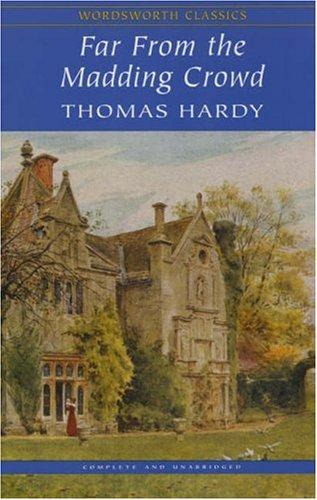
Far from the Madding Crowd
Thomas Hardy (1874)
“Three men love one woman in Hardy's Wessex — and each offers a different vision of what love demands, destroys, and endures.”
Far from the Madding Crowd— Summary & Analysis
by Thomas Hardy · published 1874 · 416 pages · Victorian
A user-friendly study guide for Far from the Madding Crowd by Thomas Hardy (1874): a high-level plot summary, full chapter-by-chapter analysis, theme breakdowns, character profiles, and 30 essay questions designed for high-school, ap-english, college readers. Unlike a stock summary, sumsumsum.com adds a diction analysis drawn from Thomas Hardy’s actual text, the 3 documented AP Literature exam appearances of this book, and reading-difficulty guidance (Easy, 3/10) so students, teachers, and lifelong readers know what they are walking into.
“Three men love one woman in Hardy's Wessex — and each offers a different vision of what love demands, destroys, and endures.”
Short Summary
Bathsheba Everdene, a beautiful and fiercely independent young woman, inherits a farm in Wessex and finds herself courted by three very different men: Gabriel Oak, a steadfast shepherd who loves her without conditions; William Boldwood, a prosperous gentleman farmer driven to obsession by a careless valentine; and Sergeant Francis Troy, a dashing soldier whose passionate charm conceals recklessness and cruelty. Troy marries Bathsheba, squanders her fortune, and disappears after the death of Fanny Robin — the woman he truly loved. When Troy returns and Boldwood shoots him dead, only Oak remains. Bathsheba, humbled and matured, finally recognizes the quiet, enduring love she had dismissed from the start.
Detailed Summary
Bathsheba Everdene first appears as a vain young woman admiring herself in a mirror atop a wagon. Gabriel Oak, a young shepherd, watches her and falls in love. He proposes; she refuses, valuing her independence over his honest but unremarkable offer. When Oak loses his entire flock to a cliff and is...
Summary in the Author’s Writing Style
A retelling of Far from the Madding Crowd in Thomas Hardy’s style — so you can hear the language, not just the plot. This is a stylistic pastiche written by sumsumsum, not an excerpt from the book.
On a morning bright enough to gild the commonest furniture of a wagon, a young woman named Bathsheba Everdene sat among her household goods and, supposing herself unobserved, drew out a small looking-glass and smiled into it. Gabriel Oak, a shepherd of no particular fortune but of a settled and pati…
If you liked Far from the Madding Crowd, read next
Start with Middlemarch by George Eliot — Eliot's panoramic study of provincial life and marriage — the intellectual companion to Hardy's pastoral examination of the same themes. Or pivot to The Age of Innocence by Edith Wharton — Another novel about choosing between passionate and respectable love — Wharton's New York drawing rooms mirror Hardy's Wessex farms as arenas of social constraint.
For comparative essays, pair Far from the Madding Crowd with
The strongest comparative pairing is Jane Eyre (Charlotte Bronte) — Another fiercely independent heroine in rural England who refuses conventional marriage — Bronte's approach is Gothic and moral where Hardy's is pastoral and psychological. For a third angle, contrast with Wuthering Heights (Emily Bronte) — The obsessive love Hardy gives Boldwood is Heathcliff's in different clothing — both novels explore love as destructive compulsion in the English countryside.
Each of these pairings opens a clean thesis path on shared themes, period diction, or formal influence — useful for AP Lit / IB / first-year college comparative essays.
More from Thomas Hardy and the scholars who study Hardy
Other works by Thomas Hardy: Jude the Obscure (1895, 432 pages), Tess of the d'Urbervilles (1891, 518 pages), The Mayor of Casterbridge (1886, 352 pages), The Return of the Native (1878, 448 pages). Reading two or three of these in sequence reveals Thomas Hardy’s recurring obsessions and stylistic signatures more clearly than any single book can.