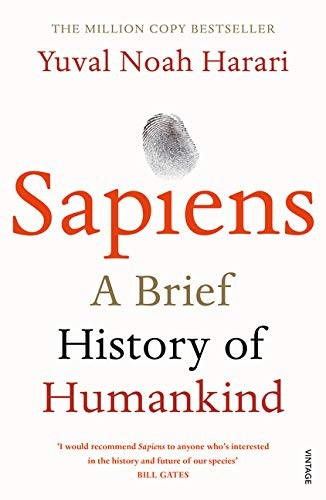
Sapiens: A Brief History of Humankind
Yuval Noah Harari (2011)
“A historian argues that everything holding civilization together — money, religion, nations, human rights — is a fiction we collectively agreed to believe.”
At a Glance
Yuval Noah Harari traces Homo sapiens from an insignificant African ape to the dominant force on the planet, arguing that our species conquered the world not through physical superiority but through a unique capacity for collective fiction — shared myths like gods, nations, money, and human rights that enable mass cooperation among strangers. He frames the Agricultural Revolution as a catastrophic trap rather than progress, charts how empires, religions, and capitalism unified humanity through imagined orders, and contends that the Scientific Revolution's true innovation was the admission of ignorance. The book closes by questioning whether any of this has made humans happier, and whether biotechnology and artificial intelligence will soon render Homo sapiens obsolete.
Read full summary →Why This Book Matters
Sapiens did something that had not been done since H.G. Wells's The Outline of History (1920): it made the entire sweep of human history accessible, engaging, and intellectually provocative for a mass audience. It sold over 25 million copies in 65+ languages and shifted public discourse about human nature, institutions, and progress. Whether or not professional historians endorse its claims, it changed how millions of people think about what it means to be human.
Diction Profile
Conversational with occasional academic precision — closer to a TED talk than a peer-reviewed journal, which is both its strength and its most criticized feature
Moderate