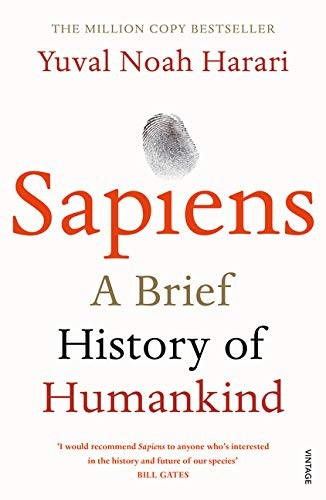
Sapiens: A Brief History of Humankind
Yuval Noah Harari (2011)
“A historian argues that everything holding civilization together — money, religion, nations, human rights — is a fiction we collectively agreed to believe.”
Why This Book Matters
Sapiens did something that had not been done since H.G. Wells's The Outline of History (1920): it made the entire sweep of human history accessible, engaging, and intellectually provocative for a mass audience. It sold over 25 million copies in 65+ languages and shifted public discourse about human nature, institutions, and progress. Whether or not professional historians endorse its claims, it changed how millions of people think about what it means to be human.
Firsts & Innovations
One of the first academic histories to be adopted as essential reading by Silicon Valley, shaping how technologists think about disruption and myth-making
Pioneered the framing of all human institutions — including human rights and liberal democracy — as 'fictions' without dismissing their importance
Made 'imagined orders' and 'inter-subjective reality' part of mainstream intellectual vocabulary
Cultural Impact
Endorsed by Barack Obama, Bill Gates, Mark Zuckerberg, and Natalie Portman — rare cross-domain reach
Translated into 65+ languages, 25+ million copies sold worldwide
Spawned a trilogy: Homo Deus (2016) and 21 Lessons for the 21st Century (2018)
Adapted as a graphic novel (2020-2022) illustrated by Daniel Casanave
Made Harari one of the most sought-after speakers at Davos, TED, and heads-of-state meetings
Influenced the vocabulary of tech industry discourse — 'shared fictions,' 'imagined orders,' and 'cognitive revolution' entered Silicon Valley parlance
Banned & Challenged
Not formally banned but has drawn criticism from religious groups who object to the characterization of religion as a 'shared fiction' equivalent to money or nationalism. Some Israeli commentators have criticized Harari's treatment of Jewish history as insufficiently distinctive. The book's moral relativism — treating all value systems as equally constructed — has been challenged by philosophers across the political spectrum.