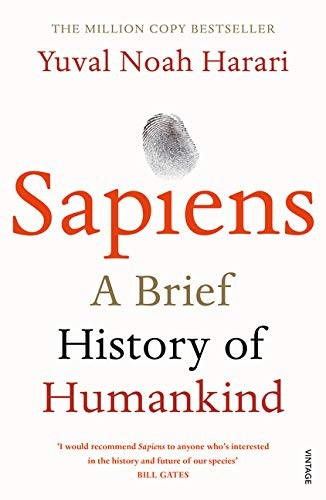
Sapiens: A Brief History of Humankind
Yuval Noah Harari (2011)
“A historian argues that everything holding civilization together — money, religion, nations, human rights — is a fiction we collectively agreed to believe.”
Essay Questions & Food for Thought
30questions designed to challenge assumptions and provoke original thinking. These can't be answered from a summary — you need the actual text.
Harari argues that the ability to create and believe in fictions is what separates Homo sapiens from all other species. Can you think of a human institution that is NOT a shared fiction in Harari's sense? If not, what does that imply about the nature of human reality?
Harari calls the Agricultural Revolution 'history's biggest fraud.' Who was defrauded, and by whom? Can a process with no conscious architect be a 'fraud'? Is Harari using the word literally or rhetorically?
If money is a shared fiction, what happens when the fiction breaks down? Use a historical example (hyperinflation, bank runs, cryptocurrency crashes) to test Harari's thesis.
Harari argues that empires, despite their violence, were the primary mechanism through which humanity unified. Is this an argument FOR empire, an argument that empire was historically necessary, or something else entirely? What is Harari's moral position?
Harari treats liberalism, communism, and capitalism as 'religions' — belief systems that function identically to traditional religions. Is this a valid comparison, or does it collapse meaningful distinctions? What is lost when we call human rights a 'fiction'?
The Scientific Revolution, Harari argues, began with the admission of ignorance. How does this compare to how science is taught in schools today — as a body of known facts or as a method for confronting the unknown?
Harari presents evidence that subjective happiness has not increased proportionally with civilization's material achievements. If this is true, what is civilization FOR? Is there a purpose to human history beyond making individuals happy?
Why did Silicon Valley embrace Sapiens so enthusiastically? What does Harari's thesis about shared fictions offer to an industry built on creating new platforms, currencies, and virtual realities?
Harari writes that 'wheat domesticated humans' rather than the reverse. Rewrite this claim without the rhetorical inversion. Does it still hold up? What work is the metaphor doing?
Harari argues that the concept of 'unnatural' behavior has no biological basis — that from a biological perspective, everything humans do is natural. What are the implications of this argument for debates about gender, sexuality, and social norms?
Professional historians have criticized Sapiens for oversimplification, rhetorical exaggeration, and selective use of evidence. Does this criticism invalidate the book's value? What is the difference between a good history and a good book about history?
Harari ends the book by asking: 'Is there anything more dangerous than dissatisfied and irresponsible gods who don't know what they want?' Unpack this sentence. Who are the gods? Why are they dissatisfied? Why irresponsible? Why don't they know what they want?
Harari's Vipassana meditation practice influenced his writing. How might a daily practice of observing one's own mind shape the way a historian thinks about happiness, suffering, and the nature of consciousness?
Compare Harari's treatment of religion with that of a believer writing about the same subject. What does Harari see that a believer might miss? What does a believer see that Harari might miss?
Harari argues that the gap between rich and poor could become biological if genetic enhancement technologies are available only to the wealthy. Is this a prediction, a warning, or an argument for regulation? How should society respond?
The book's central metaphor — that shared fictions enable cooperation — could be read as cynical (everything is a lie) or empowering (we can create better fictions). Which reading does Harari intend? Which reading do you find more useful?
Harari spends significant time on the suffering of domesticated animals, arguing that including their experience collapses the case for 'progress.' Is it legitimate to include animal suffering in a history of HUMAN civilization? Why or why not?
Harari argues that science tells us what we CAN do but not what we SHOULD do. If this is true, where should moral guidance come from in a secular, scientific society? What fills the gap that religion once occupied?
The book was published in Hebrew in 2011, during the Arab Spring. How might the spectacle of shared narratives toppling governments in real time have shaped Harari's thesis about the power of collective fiction?
Harari uses Peugeot — a car company — as his primary example of a 'fictional' entity. Why a corporation rather than a nation, religion, or currency? What does the corporate example make visible that other examples might obscure?
If you could give Sapiens to a historical figure — Hammurabi, Genghis Khan, Thomas Jefferson, Karl Marx — who would benefit most from reading it, and what would they find most challenging about Harari's framework?
Harari's Dunbar number argument (groups above ~150 require shared myths to cooperate) has been challenged by anthropologists. Research the critique. Does the argument survive if the specific number is wrong?
Harari writes from the perspective of the entire species, using 'we' throughout. What is gained and lost by this collective framing? Whose experiences are amplified, and whose are erased, when you narrate 70,000 years as a single story?
Compare Sapiens to a religious creation narrative (Genesis, the Dreamtime, the Popol Vuh). Both attempt to explain where humans came from and what our place in the world is. What structural similarities exist? Is Sapiens itself a kind of origin myth?
Harari argues that the admission of ignorance was the Scientific Revolution's greatest innovation. Apply this to your own education: in which subjects have you been taught to say 'I don't know,' and in which have you been taught that all the important answers already exist?
The book argues that European dominance resulted from the unique combination of science, capitalism, and empire — not from cultural or racial superiority. How does this argument differ from Jared Diamond's geographic determinism in Guns, Germs, and Steel? Which explanation is more convincing?
Harari's claim that 'nothing is unnatural' (from a biological perspective) has been both celebrated and criticized. Write a one-paragraph defense and a one-paragraph critique of this claim.
If Harari is right that biotechnology will create biological inequality between rich and poor, what existing institutions or legal frameworks could prevent this? Are any of them adequate?
Harari devotes significant space to the Buddhist analysis of happiness. Why does a historian of human civilization give such weight to a 2,500-year-old contemplative tradition? Is this history, philosophy, or personal advocacy?
Sapiens has sold over 25 million copies. Apply Harari's own framework to his own book: Sapiens is itself a shared fiction about shared fictions. What 'imagined order' does it create or reinforce among its readers? Has it changed any real-world institutions, or only how people talk about them?