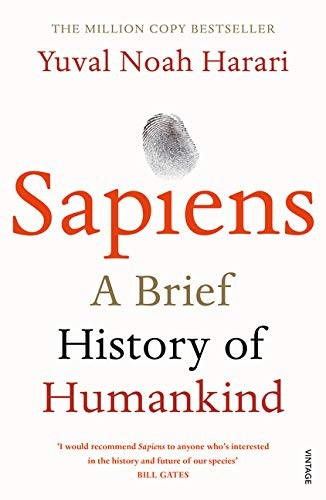
Sapiens: A Brief History of Humankind
Yuval Noah Harari (2011)
“A historian argues that everything holding civilization together — money, religion, nations, human rights — is a fiction we collectively agreed to believe.”
This page prints on a single page. Use Ctrl+P / Cmd+P.
Sapiens: A Brief History of Humankind
Yuval Noah Harari (2011) · 443pages · Contemporary Nonfiction · 1 AP appearances
Summary
Yuval Noah Harari traces Homo sapiens from an insignificant African ape to the dominant force on the planet, arguing that our species conquered the world not through physical superiority but through a unique capacity for collective fiction — shared myths like gods, nations, money, and human rights that enable mass cooperation among strangers. He frames the Agricultural Revolution as a catastrophic trap rather than progress, charts how empires, religions, and capitalism unified humanity through imagined orders, and contends that the Scientific Revolution's true innovation was the admission of ignorance. The book closes by questioning whether any of this has made humans happier, and whether biotechnology and artificial intelligence will soon render Homo sapiens obsolete.
Why It Matters
Sapiens did something that had not been done since H.G. Wells's The Outline of History (1920): it made the entire sweep of human history accessible, engaging, and intellectually provocative for a mass audience. It sold over 25 million copies in 65+ languages and shifted public discourse about hum...
Themes & Motifs
Diction & Style
Register: Conversational with occasional academic precision — closer to a TED talk than a peer-reviewed journal, which is both its strength and its most criticized feature
Narrator: Harari writes as an omniscient guide narrating the species' biography. The voice is confident, sometimes overconfiden...
Figurative Language: Moderate
Historical Context
Post-2008 — financial crisis, tech disruption, climate anxiety, rise of populism: Sapiens arrived at a moment when the fictions holding the liberal world order together were visibly cracking. The 2008 crisis revealed money as collective trust. Social media created new imagined c...
Key Characters
Talking Points
- Harari argues that the ability to create and believe in fictions is what separates Homo sapiens from all other species. Can you think of a human institution that is NOT a shared fiction in Harari's sense? If not, what does that imply about the nature of human reality?
- Harari calls the Agricultural Revolution 'history's biggest fraud.' Who was defrauded, and by whom? Can a process with no conscious architect be a 'fraud'? Is Harari using the word literally or rhetorically?
- If money is a shared fiction, what happens when the fiction breaks down? Use a historical example (hyperinflation, bank runs, cryptocurrency crashes) to test Harari's thesis.
- Harari argues that empires, despite their violence, were the primary mechanism through which humanity unified. Is this an argument FOR empire, an argument that empire was historically necessary, or something else entirely? What is Harari's moral position?
- Harari treats liberalism, communism, and capitalism as 'religions' — belief systems that function identically to traditional religions. Is this a valid comparison, or does it collapse meaningful distinctions? What is lost when we call human rights a 'fiction'?
Notable Quotes
“You could never convince a monkey to give you a banana by promising him limitless bananas after death in monkey heaven.”
“Large numbers of strangers can cooperate successfully by believing in common myths.”
“Homo sapiens conquered the world thanks above all to its unique language.”
Why Read This
Because every institution you take for granted — money, your country, your rights, your religion — is a story that humans invented and collectively agreed to believe. Once you see this, you cannot unsee it. Sapiens does not tell you what to believ...