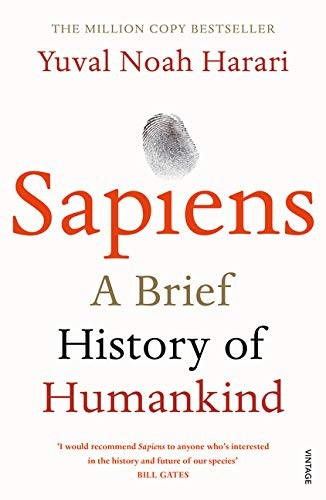
Sapiens: A Brief History of Humankind
Yuval Noah Harari (2011)
“A historian argues that everything holding civilization together — money, religion, nations, human rights — is a fiction we collectively agreed to believe.”
Language Register
Conversational with occasional academic precision — closer to a TED talk than a peer-reviewed journal, which is both its strength and its most criticized feature
Syntax Profile
Short, declarative sentences dominate. Harari favors the one-two punch structure: a conventional claim in one sentence, immediately subverted or complicated in the next. Paragraphs are short by academic standards. The pacing is closer to journalism than scholarship — designed to keep a non-specialist reader moving forward.
Figurative Language
Moderate — Harari relies more on analogy and thought experiment than on metaphor. His most effective rhetorical device is the deflationary reframe: describing something familiar (money, religion, the nation) in terms that strip away its assumed naturalness and expose its constructed character.
Era-Specific Language
Any social structure sustained by collective belief — nations, religions, corporations, human rights
Existing in the shared imagination of many people, as distinct from objective (exists regardless of belief) or subjective (exists only for one person)
Harari's term for the emergence of fictional language circa 70,000 BCE
The self-reinforcing cycle of ignorance, research, power, and growth that drives modernity
Harari's paradigm example of a legal fiction with real-world power — Peugeot exists as an imagined entity
How Characters Speak — Class & Identity
Homo sapiens (collective)
Harari consistently uses 'we' and 'our' — collapsing the distance between reader and subject, making the reader complicit in the species' history.
The inclusive 'we' is a rhetorical strategy that prevents the reader from standing outside the argument. You are sapiens. This is your story.
Harari (narrator)
Detached, analytical, occasionally sardonic. Uses the present tense for historical events ('the forager wakes up'), creating immediacy.
Harari positions himself as neither advocate nor critic but as a naturalist observing a species — including himself — from a slight remove.
Narrator's Voice
Harari writes as an omniscient guide narrating the species' biography. The voice is confident, sometimes overconfident — making sweeping claims with minimal hedging. This is the voice's power (clarity, momentum) and its vulnerability (specialists hear the hedges that are missing).
Tone Progression
Part One (Cognitive Revolution)
Deflationary, surprising, playful
Harari systematically undermines the reader's assumption of human specialness. The tone is 'you thought you knew this — you didn't.'
Part Two (Agricultural Revolution)
Provocative, contrarian, polemical
The 'biggest fraud' thesis is deliberately inflammatory. Harari is arguing a case, not reporting consensus.
Part Three (Unification & Science)
Analytical, sweeping, increasingly dark
The pace accelerates as Harari covers empires, religions, and the Scientific Revolution. The moral ambivalence deepens.
Part Four (Happiness & Future)
Philosophical, uncertain, prophetic
The confidence that characterized earlier sections gives way to genuine questioning. The final pages are deliberately unsettling.
Stylistic Comparisons
- Jared Diamond's Guns, Germs, and Steel — similar scope but Diamond emphasizes geography while Harari emphasizes cognition and myth
- Steven Pinker's The Better Angels of Our Nature — Pinker is optimistic about progress; Harari is agnostic
- Daniel Kahneman's Thinking, Fast and Slow — both challenge assumptions about human rationality, but Kahneman stays at the individual level while Harari scales to civilizations
Key Vocabulary from This Book
Notable words used in this text — click to see full definitions