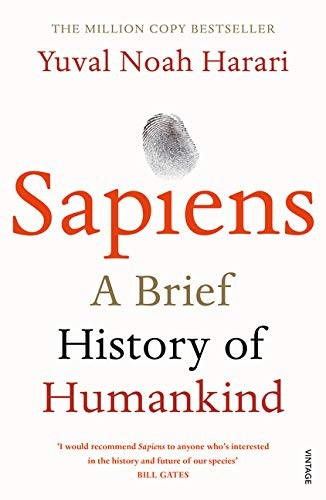
Sapiens: A Brief History of Humankind
Yuval Noah Harari (2011)
“A historian argues that everything holding civilization together — money, religion, nations, human rights — is a fiction we collectively agreed to believe.”
Sapiens: A Brief History of Humankind— Historical Context & Author Background
Author: Yuval Noah Harari · Published 2011· Era: Contemporary Nonfiction·443 pages
Themes explored: cognitive-revolution, agriculture, empire, capitalism, religion, science, happiness, future
About Yuval Noah Harari
Yuval Noah Harari (born 1976) is an Israeli historian at the Hebrew University of Jerusalem. He trained as a medieval military historian — his PhD at Oxford focused on medieval warfare and the experience of individual soldiers — before pivoting to macro-historical synthesis. He is openly gay, practices Vipassana meditation (which he credits as transformative for his thinking), and is vegan. He has described himself as 'a historian who writes about the future,' and his public persona — TED talks, Davos panels, meetings with world leaders — has made him arguably the most influential public intellectual of the 2010s. He lives with his husband Itzik Yahav on a moshav near Jerusalem.
Life → Text Connections
How Yuval Noah Harari's real experiences shaped specific elements of Sapiens: A Brief History of Humankind.
Harari is a Vipassana meditator who has attended extended silent retreats
The sympathetic treatment of Buddhism's analysis of suffering and the hedonic treadmill in the happiness chapter
Harari's personal meditation practice gives him an experiential basis for the Buddhist framework that most Western historians would treat as merely one more cultural artifact.
Harari is openly gay in a society (Israel) where LGBTQ+ rights remain politically contested
The argument that 'there is no basis in biology' for social hierarchies — including gender and sexuality norms — and that all such orders are 'imagined'
Harari's personal experience of living outside a dominant imagined order (heteronormativity) gives urgency to his argument that all social orders are constructed rather than natural.
Harari trained as a military historian studying the experience of individual soldiers in medieval wars
The persistent attention to individual suffering within grand historical narratives — the forager's daily life, the farmer's backbreaking labor, the factory-farmed chicken
His original academic focus on how grand events feel to the individuals who live through them explains why Sapiens constantly interrupts its macro-narrative to ask: but was this good for actual people?
Harari became a global celebrity after Sapiens, meeting with Merkel, Macron, and Silicon Valley executives
The argument that storytellers — those who create and maintain shared fictions — hold the real power in human societies
Harari became living proof of his own thesis: a man whose power derives entirely from telling a compelling story about how stories work.
Historical Era
Post-2008 — financial crisis, tech disruption, climate anxiety, rise of populism
How the Era Shapes the Book
Sapiens arrived at a moment when the fictions holding the liberal world order together were visibly cracking. The 2008 crisis revealed money as collective trust. Social media created new imagined communities overnight. Climate change raised the question of whether the growth story was suicidal. Harari's framework — everything is a fiction, but some fictions are more useful than others — gave readers a tool for understanding a world where institutions they had trusted were failing.
Why Sapiens: A Brief History of Humankind Matters Historically
Sapiens did something that had not been done since H.G. Wells's The Outline of History (1920): it made the entire sweep of human history accessible, engaging, and intellectually provocative for a mass audience. It sold over 25 million copies in 65+ languages and shifted public discourse about human nature, institutions, and progress. Whether or not professional historians endorse its claims, it changed how millions of people think about what it means to be human.
- One of the first academic histories to be adopted as essential reading by Silicon Valley, shaping how technologists think about disruption and myth-making
- Pioneered the framing of all human institutions — including human rights and liberal democracy — as 'fictions' without dismissing their importance
- Made 'imagined orders' and 'inter-subjective reality' part of mainstream intellectual vocabulary
Not formally banned but has drawn criticism from religious groups who object to the characterization of religion as a 'shared fiction' equivalent to money or nationalism. Some Israeli commentators have criticized Harari's treatment of Jewish history as insufficiently distinctive. The book's moral relativism — treating all value systems as equally constructed — has been challenged by philosophers across the political spectrum.