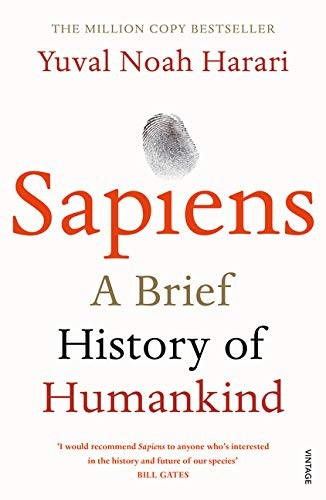
Sapiens: A Brief History of Humankind
Yuval Noah Harari (2011)
“A historian argues that everything holding civilization together — money, religion, nations, human rights — is a fiction we collectively agreed to believe.”
Sapiens: A Brief History of Humankind— Summary & Analysis
by Yuval Noah Harari · published 2011 · 443 pages · Contemporary Nonfiction
A user-friendly study guide for Sapiens: A Brief History of Humankind by Yuval Noah Harari (2011): a high-level plot summary, full chapter-by-chapter analysis, theme breakdowns, character profiles, and 30 essay questions designed for high-school, ap-english, college readers. Unlike a stock summary, sumsumsum.com adds a diction analysis drawn from Yuval Noah Harari’s actual text, the 1 documented AP Literature exam appearance of this book, and reading-difficulty guidance (Easy, 3/10) so students, teachers, and lifelong readers know what they are walking into.
“A historian argues that everything holding civilization together — money, religion, nations, human rights — is a fiction we collectively agreed to believe.”
Short Summary
Yuval Noah Harari traces Homo sapiens from an insignificant African ape to the dominant force on the planet, arguing that our species conquered the world not through physical superiority but through a unique capacity for collective fiction — shared myths like gods, nations, money, and human rights that enable mass cooperation among strangers. He frames the Agricultural Revolution as a catastrophic trap rather than progress, charts how empires, religions, and capitalism unified humanity through imagined orders, and contends that the Scientific Revolution's true innovation was the admission of ignorance. The book closes by questioning whether any of this has made humans happier, and whether biotechnology and artificial intelligence will soon render Homo sapiens obsolete.
Detailed Summary
Sapiens opens 70,000 years ago with an unremarkable primate species — one of at least six human species then living on Earth — and asks a deceptively simple question: how did this particular ape come to dominate every ecosystem, exterminate its sister species, build civilizations of millions, and no...
Chapter-by-Chapter Analysis
If you liked Sapiens: A Brief History of Humankind, read next
Start with Guns, Germs, and Steel by Jared Diamond — The closest structural predecessor — Diamond explains civilizational dominance through geography; Harari explains it through cognitive and institutional structures. Reading both reveals what each leaves out.. Then try On the Origin of Species by Charles Darwin — The book that first placed humans within the animal kingdom rather than above it — Harari's entire project is an extension of Darwin's radical decentering of Homo sapiens.. Or pivot to Thinking, Fast and Slow by Daniel Kahneman — Kahneman dismantles individual rationality the way Harari dismantles collective institutions — together they demolish the Enlightenment assumption that humans are rational actors..