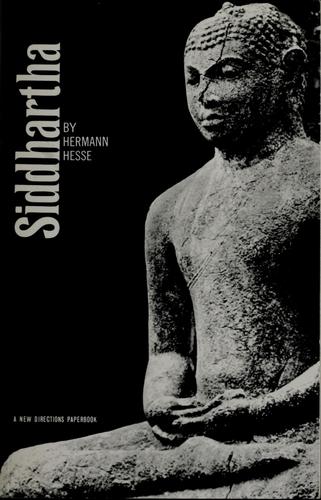
Siddhartha
Hermann Hesse (1922)
“A Brahmin's son walks away from everything — family, religion, love, wealth — in search of a self that cannot be taught.”
Siddhartha— Historical Context & Author Background
Author: Hermann Hesse · Published 1922· Era: Modernist / Eastern Philosophy·152 pages
Themes explored: enlightenment, identity, journey, wisdom, materialism, nature, time, self-discovery
About Hermann Hesse
Hermann Hesse (1877-1962) was born in Calw, Germany, to missionary parents who had both spent years in India. His maternal grandfather was a renowned Indologist, and Hesse grew up surrounded by Eastern religious texts in a deeply Protestant household — a productive tension that never resolved. He trained briefly for the ministry before breaking down, eventually becoming a writer. His first major success came with Peter Camenzind (1904), but it was Siddhartha (1922) and Steppenwolf (1927) that made his international reputation. He suffered a severe breakdown around 1916-1919, underwent Jungian psychoanalysis with Josef Lang (a student of Jung's), and emerged with the material that became Siddhartha. He won the Nobel Prize in Literature in 1946. His novels were rediscovered in the 1960s counterculture, particularly in America, where Siddhartha became required reading for the generation seeking Eastern alternatives to Western materialism.
Life → Text Connections
How Hermann Hesse's real experiences shaped specific elements of Siddhartha.
Hesse suffered a severe personal crisis around 1916-19, including the breakdown of his first marriage, his father's death, and his son's serious illness — he described the period as a near-total collapse of his sense of self
Siddhartha's crisis in Chapter 7 — the near-suicide at the river, the dream of the dead songbird, the recognition that his entire life has been a hollow performance
The psychological authenticity of Siddhartha's dark night comes directly from Hesse's own experience of disintegration. The novel is not an Eastern fantasy — it is the record of a European man's genuine spiritual emergency.
Hesse's grandfather was a renowned Indologist; he grew up reading Sanskrit texts and the Upanishads
The precision and depth of Siddhartha's Brahmin world — the rituals, the philosophical vocabulary, the concept of Atman
Hesse was not an armchair orientalist. His knowledge of Sanskrit texts and Indian philosophy was genuine and lifelong. The novel's Indian world is not exotic set dressing.
Hesse traveled to Sri Lanka and Indonesia in 1911, intending to reach India — he was deeply disappointed by the gap between his idealized image of the East and the colonial reality he found
Siddhartha's repeated discovery that no external path — not the Brahmin rituals, not the Samanas, not the Buddha's teaching — can deliver what it promises
The novel's central argument (that truth cannot be transmitted externally, only lived internally) was rooted in Hesse's own failure to find what he was looking for by traveling toward it.
Hesse underwent Jungian psychoanalysis and absorbed Jung's concept of individuation — the process of becoming fully oneself through integration of all aspects of the psyche
Siddhartha's trajectory from fragmentation (asceticism rejecting the world, wealth rejecting the spirit) to integration at the river (Om containing everything)
Hesse's novel is as much a Jungian individuation narrative as it is a Hindu-Buddhist spiritual journey. The two frameworks reinforce each other: the Self that Siddhartha seeks is both the Atman and the Jungian integrated Self.
Historical Era
Published 1922, Weimar Republic Germany — written between 1919 and 1922 in the aftermath of World War One
How the Era Shapes the Book
Siddhartha is a post-war novel masquerading as an ancient Indian tale. The question it asks — what is a self, and how does one find it when every external authority has failed? — was the burning question of 1922 Germany. The Brahmin's son walking away from his tradition resonated with a generation that had watched its tradition destroy itself in the trenches. The novel's Eastern setting allowed German readers to ask Western questions in a displaced register — to critique materialism, nationalism, and institutional religion without naming any of them directly.
Why Siddhartha Matters Historically
Published in 1922 to modest success, Siddhartha became one of the most widely read novels in the world during the 1960s and 70s counterculture movements, particularly in the United States, where it sold millions of copies. It remains a standard text in high school and college comparative literature and world religion courses. Hesse won the Nobel Prize in 1946, partly on the strength of this novel and Steppenwolf.
- One of the first major Western novels to present Eastern religious philosophy from the inside, without either orientalist exoticism or condescension
- Pioneered the use of meditative prose rhythm as a structural device — the prose is the teaching, not just a vehicle for it
- One of the first bildungsromans to make the failure of all external education the central plot event — Siddhartha learns nothing from his teachers, which is the point
Banned in Nazi Germany (1933-1945) partly because Hesse had been an outspoken pacifist critic of German nationalism in World War One, and partly because of the novel's celebration of Eastern (non-Aryan) philosophy. Hesse lived in Switzerland from 1912 onward and was effectively exiled from German literary culture during the Nazi period.