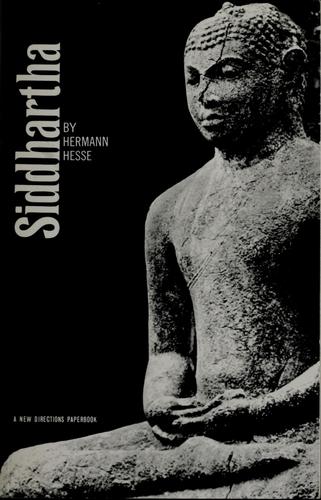
Siddhartha
Hermann Hesse (1922)
“A Brahmin's son walks away from everything — family, religion, love, wealth — in search of a self that cannot be taught.”
Language Register
Formal, incantatory — closer to sacred text than to social novel. Eschews colloquialism entirely.
Syntax Profile
Declarative, incantatory sentences that often repeat grammatical structures across successive clauses. Hesse uses parallelism extensively — 'He learned this... He learned that...' — creating the rhythm of chant or prayer. The simple sentence structure is deliberate: Hesse was writing a novel that sounds like a sacred text translated into a modern language. Dialogue is rare; when it appears, it is precise and weighted.
Figurative Language
Moderate but highly concentrated. Hesse uses the river as a sustained metaphor that develops across the entire second half of the novel. His figures are not decorative but structural — they carry philosophical weight. The river is not described like a river; it IS time, change, simultaneity, Om. Nature throughout the novel functions as the only reliable mirror of spiritual states.
Era-Specific Language
The eternal Self in Hindu philosophy — distinct from ego, the unchanging essence
Sacred syllable representing the totality of existence — appears at crisis and enlightenment
Highest Hindu priestly caste — Siddhartha's origin, the world he walks away from
Wandering ascetics practicing extreme self-mortification — Siddhartha's first teachers
The cycle of suffering and rebirth — names Siddhartha's chapter of worldly degradation
Extinction of the self's craving — Buddhist goal, which Siddhartha seeks but through his own path
Hesse's term for ordinary people living in unreflective desire — not contemptuous but compassionate irony
How Characters Speak — Class & Identity
Siddhartha
Speech shifts with each phase — formal and philosophical as a Brahmin, spare and impersonal as a Samana, worldly and assured with Kamala, and finally simple, direct, and patient as a ferryman. Each register is authentic to that phase.
Social class is a costume in this novel, not a fixed identity. Siddhartha's speech is always precisely calibrated to his current practice — which is itself a comment on the performativity of identity.
Govinda
Devoted, formal, earnest — his speech never changes much across the novel. He speaks the language of the disciple throughout, always addressing others as teachers.
The follower's language: respectful, seeking, slightly formal. Govinda's consistency of register mirrors his consistency of method — always seeking, always asking, never quite receiving.
Kamala
Worldly, warm, practical — she speaks the language of transaction and pleasure. Her speech is the only one in the novel that sounds genuinely urban and contemporary.
Her worldliness is intelligence of a different order. She understands desire, time, and loss with the precision of someone who has lived them fully — and her speech reflects this direct engagement with material reality.
Kamaswami
Brisk, commercial, impatient — his speech is the language of the market, focused on gain and loss, practical consequence.
The merchant's consciousness: all things measured in outcome. His frustration with Siddhartha's detachment is the frustration of a man who cannot understand why someone would not care about winning.
Vasudeva
Almost no speech at all — his language is listening. When he does speak, his sentences are among the shortest in the novel. One or two words, sometimes a question, sometimes just a sound of acknowledgment.
Hesse's deepest claim: the most enlightened character in the novel barely speaks. Wisdom at its highest register is silence. Vasudeva embodies what all of Siddhartha's teachers could only describe.
The Ferryman (Vasudeva in role)
Simple, non-hierarchical, completely present. He speaks to merchants and monks and beggars with the same quality of attention.
The dissolution of social hierarchy as a spiritual achievement. At the river, everyone is just a person crossing water.
Narrator's Voice
Third-person omniscient, but intimate — the narrator knows Siddhartha's interior completely and renders it with the same calm authority as Vasudeva listens. The voice is Hesse's most controlled: no irony, no distance, no unreliability. Unlike Nick Carraway or Holden Caulfield, this narrator is not a character with an agenda — it is closer to the voice of the river itself.
Tone Progression
Chapters 1-3 (Part One)
Reverent, restless, intellectually urgent
The tone of a gifted student at the edge of real understanding. Formal and somewhat ceremonial, as befits the Brahmin world.
Chapters 4-7 (Part One/Two transition)
Awakening, sensory, ironic
The prose warms and opens as Siddhartha enters the world. A gentle irony attaches to the 'childlike people' sections — not mockery but the smile of someone watching from outside.
Chapters 8-12 (Part Two)
Meditative, patient, finally transcendent
The tone of the river chapters is the novel's achievement — genuinely still without being dull, patient without being passive. The final vision breaks into something close to ecstatic prose before returning to simplicity.
Stylistic Comparisons
- The Buddha's own discourse records (Pali Canon) — Hesse's prose echoes the deliberate repetition and parallel structure of Buddhist sutras
- Rilke's Duino Elegies — same meditative intensity, same willingness to slow time to the speed of perception
- Tolstoy's The Death of Ivan Ilyich — another brief novel about a man who nearly dies before understanding how to live
Key Vocabulary from This Book
Notable words used in this text — click to see full definitions