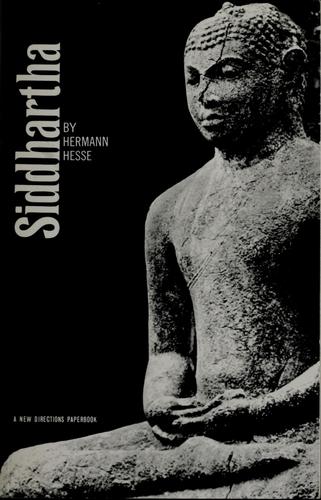
Siddhartha
Hermann Hesse (1922)
“A Brahmin's son walks away from everything — family, religion, love, wealth — in search of a self that cannot be taught.”
Essay Questions & Food for Thought
30questions designed to challenge assumptions and provoke original thinking. These can't be answered from a summary — you need the actual text.
Siddhartha rejects the Buddha's teaching even though he recognizes Gautama as genuinely enlightened. Is his argument logically sound? Can spiritual experience be transmitted through doctrine?
Hesse names his protagonist Siddhartha — the birth name of the historical Buddha — but his Siddhartha is not the Buddha and explicitly refuses to follow him. What is Hesse arguing by using this name?
Govinda follows every external teacher his entire life — the Samanas, the Buddha — and finds enlightenment only at the very end, through contact with Siddhartha rather than through doctrine. Is Govinda's path inferior, or just different?
Hesse describes the ordinary people of the city as 'childlike people' — a term that mixes compassion with condescension. Does Siddhartha actually overcome his superiority complex? Find evidence for both sides.
The river appears at every major turning point in the novel. Map every appearance of the river and trace how Siddhartha's relationship to it changes. What does this tell you about Hesse's use of setting as symbol?
Kamala is a courtesan — a figure often dismissed or romanticized in literature. How does Hesse portray her wisdom, and what does it suggest that her kind of knowledge (the knowledge of desire) is necessary to Siddhartha's education?
Vasudeva barely speaks. How does Hesse convey his wisdom without dialogue? What techniques does he use to make silence a form of teaching?
The novel argues that 'knowledge can be conveyed, but not wisdom.' Do you agree? Can you think of something you know intellectually but cannot fully understand until you've experienced it?
Siddhartha's crisis in Chapter 7 (Samsara) is triggered not by suffering but by emptiness — by living well and feeling nothing. Is meaningless comfort worse than meaningful suffering? Use the novel to argue your answer.
When Siddhartha's son runs away, Siddhartha wants to follow him against the river's teaching. Vasudeva stops him. Was this the right thing to do? Did Siddhartha have a parental obligation that transcended his spiritual path?
The historical context matters: Hesse published this novel in 1922 Germany, after World War One had discredited European civilization. How does this context change your reading of the novel's critique of materialism and institutional religion?
The river teaches that time is simultaneous — past, present, and future all existing at once. If you accept this view of time, what happens to regret? To hope? How does this teaching make ordinary life livable?
Compare Siddhartha's father's all-night vigil (Chapter 1) to Siddhartha's own grief when his son runs away (Chapter 10). What has changed? What hasn't?
Hesse was a European writing about ancient India. Is Siddhartha an authentic portrayal of Indian philosophy, or a Western fantasy of the East? Does it matter?
The novel's prose style is itself an argument. How does the meditative, repetitive, incantatory sentence structure enact the spiritual practice it describes? Give specific examples.
Siddhartha never joins a religious organization — he rejects the Samanas, refuses the Buddhists, and lives as a ferryman rather than a priest. Is the novel anti-institutional? What does it suggest about organized religion?
Govinda sees his final vision not through meditation or doctrine, but through physical contact with Siddhartha — pressing his lips to his forehead. Why does Hesse use physical touch as the medium for the novel's climactic moment?
Siddhartha has a son he abandons (by walking away from his city life) and a son who abandons him (by running away from the river). Is this karma, symmetry, or coincidence? How does the structure of the novel make you answer?
Compare Siddhartha to Siddhartha Gautama (the historical Buddha). What do they share? Where do they diverge? What is Hesse suggesting about the relationship between the historical Buddha's path and the path available to everyone?
The novel was rediscovered by the American counterculture in the 1960s and became a bestseller. Why did this particular novel resonate so deeply with that generation? Would it resonate the same way today?
Siddhartha argues that Samana meditation is not qualitatively different from getting drunk — both are temporary ego-dissolutions that end with you back where you started. Is this a fair critique? Defend or challenge it.
The character of Kamala dies of a snakebite while on pilgrimage to hear the dying Buddha. What is Hesse saying about the relationship between love, wisdom, and death with this narrative arrangement?
The novel ends not with a statement but with a vision and a bow. Why does Hesse refuse to state his conclusion? What is he arguing about the nature of the truth he's been approaching all novel?
Siddhartha's path requires economic privilege — he is born a Brahmin, can afford to leave, can learn business quickly because he's educated. Is the enlightenment this novel offers available to everyone, or only to the fortunate?
Hesse won the Nobel Prize in 1946. His books were banned in Nazi Germany. His antiwar pacifism made him a pariah in World War One. How does knowing that this novel's author was a man in genuine political exile change your reading of its themes of belonging and withdrawal?
What is the relationship between suffering and enlightenment in this novel? Does Siddhartha need to suffer as much as he does — or is there a shorter path?
The novel presents time as simultaneously linear (Siddhartha ages, things happen in sequence) and simultaneous (the river contains all time at once). How does Hesse manage this paradox structurally? Does the novel's form reflect its content?
If Siddhartha had followed the Buddha (as Govinda did), do you think he would have achieved enlightenment? Why or why not?
Read the river-voices passage in Chapter 11 aloud. What is Hesse's prose doing with sound and rhythm that he cannot do with argument alone? How does the passage feel different from the philosophical dialogue in Chapter 3?
The novel ends with Govinda weeping and bowing. What is he weeping for? Write the conversation Govinda might have with a young monk the next morning, if he tried to explain what he experienced at the river — and why it couldn't quite be explained.