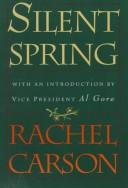
Silent Spring
Rachel Carson (1962)
“A marine biologist dying of cancer wrote the book that killed DDT, launched the environmental movement, and proved that one careful voice could take on an entire industry — and win.”
This page prints on a single page. Use Ctrl+P / Cmd+P.
Silent Spring
Rachel Carson (1962) · 368pages · Contemporary · 4 AP appearances
Summary
Rachel Carson meticulously documents how synthetic pesticides — particularly DDT — are poisoning the natural world, contaminating water, killing birds and fish, and threatening human health. Drawing on years of scientific research, government reports, and firsthand accounts, Carson argues that the chemical industry and the government agencies meant to regulate it have created an ecological catastrophe through ignorance, arrogance, and profit motive. The book opens with a fable of a poisoned town and closes with a call for biological alternatives to chemical warfare against nature. It changed the world.
Why It Matters
Silent Spring is arguably the most consequential work of nonfiction published in the twentieth century. It did not merely document an environmental crisis — it created the intellectual and political framework within which environmental crises could be understood, debated, and addressed. Before Ca...
Themes & Motifs
Diction & Style
Register: Elevated but accessible — Carson writes with the precision of a research scientist and the grace of a literary essayist. Her vocabulary ranges from molecular chemistry to pastoral description, and the transitions between registers are seamless. The prose never condescends and never obscures.
Narrator: Carson: controlled, authoritative, morally engaged but scientifically disciplined. She does not conceal her outrage, ...
Figurative Language: Moderate and precisely controlled. Carson uses metaphor and imagery when they serve the argument
Historical Context
Cold War America, 1945-1962 — the era of technological optimism, chemical agriculture, and unquestioned industrial growth: Silent Spring was published at the height of American technological optimism — the era that split the atom, cured polio, and was putting a man on the moon. The cultural assumption was that science ...
Key Characters
Talking Points
- Carson opens Silent Spring with a fable rather than with scientific data. Why? What does the fable accomplish that a data-driven opening could not?
- The chemical industry attacked Carson as 'hysterical,' 'emotional,' and 'a spinster.' These attacks were explicitly gendered. How does understanding this context change your reading of Carson's deliberately restrained, evidence-based prose style?
- Carson was dying of breast cancer while writing the chapters on pesticides and cancer, but she never mentions her illness in the book. Was this concealment ethical? What would the book have gained or lost if she had disclosed her diagnosis?
- Carson writes: 'The control of nature is a phrase conceived in arrogance.' What worldview is she attacking? Is there a version of 'controlling nature' that Carson would accept?
- Compare Silent Spring to Upton Sinclair's The Jungle. Both are works of investigative nonfiction that changed federal policy. What are the key differences in their rhetorical strategies? Which strategy is more effective and why?
Notable Quotes
“There was once a town in the heart of America where all life seemed to live in harmony with its surroundings.”
“No witchcraft, no enemy action had silenced the rebirth of new life in this stricken world. The people had done it themselves.”
“In the entire water-pollution problem, there is probably nothing more disturbing than the threat of widespread contamination of groundwater.”
Why Read This
Because it shows you what one person can do with evidence, clarity, and courage — and because the chemical industry's playbook against Carson is the same playbook used today against climate scientists, vaccine researchers, and anyone who challenge...