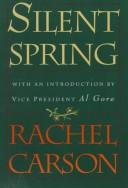
Silent Spring
Rachel Carson (1962)
“A marine biologist dying of cancer wrote the book that killed DDT, launched the environmental movement, and proved that one careful voice could take on an entire industry — and win.”
Silent Spring— Historical Context & Author Background
Author: Rachel Carson · Published 1962· Era: Contemporary·368 pages
Themes explored: nature, science, ethics, power, courage, truth
About Rachel Carson
Rachel Louise Carson was born May 27, 1907, in Springdale, Pennsylvania, on a 65-acre family farm. Her mother, Maria, instilled in her a deep love of nature and literature. Carson studied biology at the Pennsylvania College for Women (now Chatham University) and earned a master's degree in zoology from Johns Hopkins University in 1932 — an exceptional achievement for a woman in the sciences at that time. She worked as a marine biologist for the U.S. Bureau of Fisheries (later the Fish and Wildlife Service) from 1936 to 1952, eventually becoming editor-in-chief of all FWS publications. She published three books about the sea — Under the Sea-Wind (1941), The Sea Around Us (1951), and The Edge of the Sea (1955) — establishing herself as one of America's finest science writers. The Sea Around Us spent 86 weeks on the New York Times bestseller list. Carson never married. She cared for her mother and, after the death of her niece, adopted her grandnephew Roger. She was diagnosed with breast cancer in 1960, underwent a radical mastectomy, and received radiation and chemotherapy while researching and writing Silent Spring. She kept her diagnosis secret from all but her closest friends, understanding that the chemical industry would use her illness to discredit the book. She died on April 14, 1964, at age 56, eighteen months after Silent Spring's publication. She did not live to see the DDT ban (1972) or the creation of the EPA (1970), both of which were direct consequences of her work. She was posthumously awarded the Presidential Medal of Freedom in 1980.
Life → Text Connections
How Rachel Carson's real experiences shaped specific elements of Silent Spring.
Carson was dying of breast cancer while writing the chapters on pesticides and cancer
She never once mentions her illness in the book — the cancer chapters argue entirely from published scientific evidence, not personal experience
The concealment was strategic: if the chemical industry knew she had cancer, they would dismiss the entire book as a dying woman's emotional crusade. By keeping it secret, she forced the debate onto the science. The courage required to maintain this discipline while undergoing chemotherapy is staggering.
Carson was a government scientist for 16 years — she understood the regulatory system from inside
Her critique of the USDA and the regulatory framework is not an outsider's attack but an insider's exposé, built on firsthand knowledge of how government science was funded, published, and suppressed
Carson knew which scientists had been silenced, which reports had been buried, which programs had been launched over the objections of the agency's own biologists. Her institutional knowledge gave the book a specificity that no outsider could have achieved.
She was a woman with no university appointment and no institutional backing, challenging the most powerful industry in postwar America
The chemical industry's attacks on Carson were explicitly and viciously gendered — she was called hysterical, emotional, a bird lover, a spinster, a nature priestess
The gendered attacks reveal what the industry feared: not that Carson was wrong, but that she was right and could not be controlled through the usual institutional channels. She had no tenure to lose, no corporate sponsor to threaten, no husband whose career could be damaged. She was, from the industry's perspective, terrifyingly independent.
Carson's three sea books established her as a lyric poet of the natural world before she became its defender
The literary quality of Silent Spring — the opening fable, the pastoral descriptions, the elegance of the prose — is inseparable from its scientific argument. She could make readers see what was being destroyed because she had spent two decades making them see its beauty
A scientist with Carson's evidence but without her literary gifts would have written a report. Carson wrote a book that changed a civilization. The writing is not decoration — it is the delivery mechanism for the argument.
Carson adopted her grandnephew Roger after her niece's death — she was raising a child while dying
The chapters on children's vulnerability to pesticide exposure carry a weight that connects to her personal life, though she never makes the connection explicit
Carson's argument about protecting children is both scientific and deeply personal. She was a mother by adoption, raising a young boy, and she was dying of the very disease she was documenting. The intersection of the personal and the scientific gives these chapters a gravity that purely academic arguments cannot achieve.
Historical Era
Cold War America, 1945-1962 — the era of technological optimism, chemical agriculture, and unquestioned industrial growth
How the Era Shapes the Book
Silent Spring was published at the height of American technological optimism — the era that split the atom, cured polio, and was putting a man on the moon. The cultural assumption was that science and industry were unambiguously good, and that anyone who questioned technological progress was anti-modern. Carson challenged this assumption at its foundation: she argued that a technology could be scientifically sophisticated and ecologically catastrophic at the same time. The book's power came partly from its timing — it arrived just as the postwar consensus about progress was beginning to crack, and it helped crack it further. The environmental movement that followed — Earth Day in 1970, the EPA, the Clean Air Act, the Clean Water Act — was not created by Silent Spring alone, but Silent Spring made it thinkable.
Why Silent Spring Matters Historically
Silent Spring is arguably the most consequential work of nonfiction published in the twentieth century. It did not merely document an environmental crisis — it created the intellectual and political framework within which environmental crises could be understood, debated, and addressed. Before Carson, there was no 'environmental movement' in the modern sense. The concept of ecology as a public concern, the idea that industrial activities could have systemic environmental consequences, the principle that government had a responsibility to protect natural systems — all of these ideas existed in specialized scientific circles, but Carson brought them to the American public in a form that could not be ignored.
- First major work to present ecological thinking — the interconnectedness of natural systems — to a mass audience
- First bestselling book to argue that synthetic chemicals could cause cancer through chronic low-dose exposure
- Introduced the concept of bioaccumulation to the general public, years before the mechanism was fully confirmed by laboratory research
- Pioneered the genre of environmental investigative nonfiction — the template for every environmental book that followed
- First work to successfully challenge the postwar ideology of unlimited technological progress
Silent Spring was not banned in the traditional sense but was subjected to an unprecedented industry-funded campaign to suppress and discredit it. The chemical industry trade group spent over $250,000 (equivalent to roughly $2.5 million today) to attack Carson personally and professionally. Velsicol Chemical Company threatened Carson's publisher Houghton Mifflin with a lawsuit before publication. The National Agricultural Chemicals Association distributed hostile reviews to media outlets. Individual attacks called Carson a communist, a nature fanatic, and a hysterical woman. The book has periodically been challenged in school curricula by groups who argue it led to the DDT ban that they claim increased malaria deaths in developing countries — a claim that substantially misrepresents both Carson's arguments and the history of DDT use in malaria control.