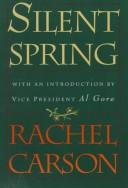
Silent Spring
Rachel Carson (1962)
“A marine biologist dying of cancer wrote the book that killed DDT, launched the environmental movement, and proved that one careful voice could take on an entire industry — and win.”
Essay Questions & Food for Thought
30questions designed to challenge assumptions and provoke original thinking. These can't be answered from a summary — you need the actual text.
Carson opens Silent Spring with a fable rather than with scientific data. Why? What does the fable accomplish that a data-driven opening could not?
The chemical industry attacked Carson as 'hysterical,' 'emotional,' and 'a spinster.' These attacks were explicitly gendered. How does understanding this context change your reading of Carson's deliberately restrained, evidence-based prose style?
Carson was dying of breast cancer while writing the chapters on pesticides and cancer, but she never mentions her illness in the book. Was this concealment ethical? What would the book have gained or lost if she had disclosed her diagnosis?
Carson writes: 'The control of nature is a phrase conceived in arrogance.' What worldview is she attacking? Is there a version of 'controlling nature' that Carson would accept?
Compare Silent Spring to Upton Sinclair's The Jungle. Both are works of investigative nonfiction that changed federal policy. What are the key differences in their rhetorical strategies? Which strategy is more effective and why?
Carson introduces the concept of bioaccumulation — chemicals concentrating as they move up the food chain. Why was this concept revolutionary in 1962, and why does it remain central to environmental science today?
The USDA fire ant eradication program killed millions of birds and fish but failed to eliminate fire ants. Carson presents this as evidence of a fundamental failure in thinking, not just a technical failure in execution. What is the conceptual error she identifies?
Carson argues for the precautionary principle: when evidence of harm is substantial and consequences potentially irreversible, the burden of proof should fall on the party proposing to use the chemical. The chemical industry argued the opposite. Which position do you find more persuasive, and what are the costs of each?
How does Carson's description of the natural world — the robin's feeding habits, the soil's microbial life, the salmon's lifecycle — function as part of her argument? Could the same argument be made without the lyrical natural description?
Carson was a government scientist for 16 years before writing Silent Spring. How does her insider knowledge of the regulatory system shape her critique? Is the critique more credible because she was inside the system?
The chemical industry's campaign against Silent Spring cost over $250,000 in 1962 dollars. Why did they consider a single book by a single author to be that threatening? What does the scale of the response tell you about the power of the argument?
Carson presents biological pest control — natural predators, sterilization, microbial agents — as an alternative to chemical spraying. Critics called her naive and anti-science. Is biological pest control genuinely 'anti-science,' or is it a different kind of science?
Silent Spring has been credited with directly leading to the creation of the EPA (1970) and the DDT ban (1972). Can a single book change policy? What conditions must exist for a book to have that kind of power?
Some critics argue that the DDT ban Carson inspired caused millions of malaria deaths in developing countries where DDT was used to control mosquitoes. How would you evaluate this claim using Carson's actual arguments in the text?
Carson writes about the 'obligation to endure' — the idea that the public is forced to absorb chemical risks it never consented to. How does this argument connect to contemporary debates about pollution, climate change, or industrial food production?
The title 'Silent Spring' is a metaphor — spring without birdsong. How does this metaphor function throughout the book? What would be lost if the book were titled 'The Pesticide Problem' instead?
Carson's prose is often described as 'poetic' or 'lyrical.' But she was a trained scientist writing a scientific argument. Is the beauty of the writing a strength or a vulnerability? Could it be used to dismiss the argument as 'emotional'?
Compare Carson's Silent Spring to Thoreau's Walden. Both are works of American nature writing with ethical arguments. How do their relationships to nature differ? How do their relationships to society differ?
Carson argues that the regulatory system placed the burden of proof on the public — requiring citizens to prove a chemical was dangerous rather than requiring companies to prove it was safe. Is this an accurate description of how regulation works today? Has anything changed since 1962?
Carson was attacked as anti-progress. She responded that she was pro-science — that her position required more scientific knowledge, not less. Can you be pro-science and still oppose a specific technology? What does Carson's example suggest about the relationship between science and industry?
The CBS Reports documentary on Silent Spring was watched by 15 million people and three of the five sponsors pulled their ads under chemical industry pressure. What does this tell you about the relationship between media, industry, and public information?
Carson's fable describes a town where children sicken and die. The chemical industry accused her of fear-mongering. At what point does a legitimate scientific warning become 'fear-mongering'? Who gets to make that distinction?
Carson never uses the word 'environmentalism' in Silent Spring — the word barely existed in 1962. How did she create a movement without a name for it? What does this suggest about the relationship between language and social change?
Compare the chemical industry's response to Silent Spring with the tobacco industry's response to cancer research or the fossil fuel industry's response to climate science. What patterns do you see? What does this suggest about how industries respond to inconvenient science?
Carson argues that nature is a complex, interconnected system that cannot be safely simplified. The chemical industry treated nature as a collection of separate problems that could be solved individually. Which view does the evidence support? Can you think of modern examples where this debate continues?
If Carson were writing Silent Spring today, which chemicals or environmental issues would she focus on? What would her 'fable for tomorrow' describe?
Carson's book was vindicated by Kennedy's Science Advisory Committee within eight months of publication. Does the speed of the vindication suggest that the scientific community already knew what Carson was saying? If so, why did it take a book for the public to find out?
Carson is sometimes called the mother of the environmental movement. Is this fair? What does it mean to credit a movement to a single person? What does it erase?
The bald eagle — America's national symbol — was driven to near-extinction by DDT and recovered after the ban Carson's work inspired. Is this fact more or less powerful as a rhetorical argument than any data Carson presents in the book? What does this say about how people respond to symbols versus statistics?
Carson closes the book by presenting a choice between two roads — continued chemical warfare against nature, or a path of biological understanding and ecological management. Has the world taken either road? Or are we still standing at the fork?