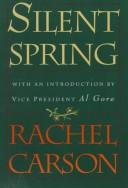
Silent Spring
Rachel Carson (1962)
“A marine biologist dying of cancer wrote the book that killed DDT, launched the environmental movement, and proved that one careful voice could take on an entire industry — and win.”
Silent Spring— Literary & Historical Significance
Why This Book Matters
Silent Spring is arguably the most consequential work of nonfiction published in the twentieth century. It did not merely document an environmental crisis — it created the intellectual and political framework within which environmental crises could be understood, debated, and addressed. Before Carson, there was no 'environmental movement' in the modern sense. The concept of ecology as a public concern, the idea that industrial activities could have systemic environmental consequences, the principle that government had a responsibility to protect natural systems — all of these ideas existed in specialized scientific circles, but Carson brought them to the American public in a form that could not be ignored.
Firsts & Innovations
First major work to present ecological thinking — the interconnectedness of natural systems — to a mass audience
First bestselling book to argue that synthetic chemicals could cause cancer through chronic low-dose exposure
Introduced the concept of bioaccumulation to the general public, years before the mechanism was fully confirmed by laboratory research
Pioneered the genre of environmental investigative nonfiction — the template for every environmental book that followed
First work to successfully challenge the postwar ideology of unlimited technological progress
Cultural Impact
Directly catalyzed the creation of the U.S. Environmental Protection Agency (1970)
Led to the federal ban on DDT in the United States (1972) and subsequent international restrictions
Inspired Earth Day (1970) and the modern environmental movement
Influenced the passage of the Clean Air Act (1963, strengthened 1970), Clean Water Act (1972), and Endangered Species Act (1973)
The bald eagle, peregrine falcon, and brown pelican recovered from near-extinction after DDT was banned — Silent Spring saved the national bird
Established the template for science-based environmental advocacy that continues through climate change activism today
Named by the Modern Library as one of the 25 greatest nonfiction works of the twentieth century
Banned & Challenged
Silent Spring was not banned in the traditional sense but was subjected to an unprecedented industry-funded campaign to suppress and discredit it. The chemical industry trade group spent over $250,000 (equivalent to roughly $2.5 million today) to attack Carson personally and professionally. Velsicol Chemical Company threatened Carson's publisher Houghton Mifflin with a lawsuit before publication. The National Agricultural Chemicals Association distributed hostile reviews to media outlets. Individual attacks called Carson a communist, a nature fanatic, and a hysterical woman. The book has periodically been challenged in school curricula by groups who argue it led to the DDT ban that they claim increased malaria deaths in developing countries — a claim that substantially misrepresents both Carson's arguments and the history of DDT use in malaria control.