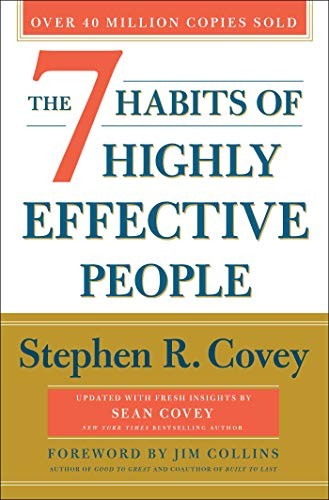
The 7 Habits of Highly Effective People
Stephen R. Covey (1989)
“Covey argues that true effectiveness begins not with techniques or tricks but with a fundamental shift in character — from dependence to independence to interdependence — and that the principles governing this shift are as immutable as the laws of physics.”
This page prints on a single page. Use Ctrl+P / Cmd+P.
The 7 Habits of Highly Effective People
Stephen R. Covey (1989) · 381pages · Late 20th Century
Summary
Stephen Covey's landmark book presents seven habits organized along a maturity continuum from dependence to independence to interdependence. The first three habits (be proactive, begin with the end in mind, put first things first) address personal mastery; the next three (think win-win, seek first to understand, synergize) address interpersonal effectiveness; and the seventh (sharpen the saw) addresses continuous renewal. Covey argues that lasting effectiveness requires a character-based ethic grounded in universal principles, not the personality-based shortcuts of the modern self-help industry.
Why It Matters
The 7 Habits of Highly Effective People transformed the self-help genre by reintroducing philosophical depth and character ethics to a field that had become dominated by personality techniques and quick fixes. It is one of the best-selling nonfiction books of the twentieth century and has influen...
Themes & Motifs
Diction & Style
Register: Moderate to high. Covey uses formal vocabulary and careful sentence construction but avoids academic jargon. His paragraphs are well-organized, his arguments are logically structured, and his tone is consistently earnest and authoritative. He writes with more gravitas than Carnegie and more clarity than Hill.
Narrator: First person, reflective, and pedagogical. Covey writes as a teacher sharing a system he has developed through decade...
Figurative Language: Moderate. Covey's metaphors are functional rather than poetic
Historical Context
The Late Cold War and the Rise of Corporate Culture (1980s): The 7 Habits was published at a moment of cultural transition — the end of the Cold War, the beginning of globalization, and a growing sense that American corporate culture needed more substance th...
Key Characters
Talking Points
- Covey argues that the shift from Character Ethic to Personality Ethic represents a decline in the quality of American success literature. Is this a fair characterization, or does Covey romanticize the past?
- How does Covey's concept of proactivity differ from simple positive thinking? What philosophical tradition does proactivity draw on, and how does that tradition shape Covey's argument?
- Covey's Time Management Matrix suggests that most people spend too much time on urgent-but-not-important activities. Identify examples from your own life in each quadrant and analyze why Quadrant II activities are so consistently neglected.
- How does the concept of the Emotional Bank Account change the way you think about trust in relationships? Identify three deposits and three withdrawals from a relationship in your own life.
- Covey argues that empathic listening — listening to understand rather than to reply — is the most important communication skill. Why is this skill so rare, and what makes it so difficult to practice?
Notable Quotes
“We see the world, not as it is, but as we are — or, as we are conditioned to see it.”
“The way we see the problem is the problem.”
“If you want to have a happy marriage, be the kind of person who generates positive energy and sidesteps negative energy rather than empowering it.”
Why Read This
The 7 Habits provides a comprehensive framework for personal effectiveness that is directly applicable to academic success, career preparation, and relationship building. The habits of proactivity, prioritization, empathic listening, and continuou...