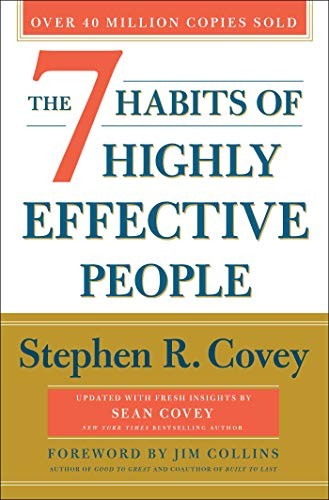
The 7 Habits of Highly Effective People
Stephen R. Covey (1989)
“Covey argues that true effectiveness begins not with techniques or tricks but with a fundamental shift in character — from dependence to independence to interdependence — and that the principles governing this shift are as immutable as the laws of physics.”
Essay Questions & Food for Thought
12questions designed to challenge assumptions and provoke original thinking. These can't be answered from a summary — you need the actual text.
Covey argues that the shift from Character Ethic to Personality Ethic represents a decline in the quality of American success literature. Is this a fair characterization, or does Covey romanticize the past?
How does Covey's concept of proactivity differ from simple positive thinking? What philosophical tradition does proactivity draw on, and how does that tradition shape Covey's argument?
Covey's Time Management Matrix suggests that most people spend too much time on urgent-but-not-important activities. Identify examples from your own life in each quadrant and analyze why Quadrant II activities are so consistently neglected.
How does the concept of the Emotional Bank Account change the way you think about trust in relationships? Identify three deposits and three withdrawals from a relationship in your own life.
Covey argues that empathic listening — listening to understand rather than to reply — is the most important communication skill. Why is this skill so rare, and what makes it so difficult to practice?
Covey's concept of synergy requires valuing differences. In what ways might this principle conflict with the human tendency toward homophily — the preference for interacting with people who are similar to oneself?
Compare Covey's Win-Win paradigm with the game theory concept of the Prisoner's Dilemma. Under what conditions is Win-Win a rational strategy, and under what conditions might it be exploited?
Covey criticizes the Personality Ethic while simultaneously writing a book about how to be more effective in relationships. Is there a tension between his critique of technique-based approaches and his own technique-heavy habits?
How does Covey's concept of 'Sharpen the Saw' relate to modern discussions about work-life balance, burnout, and self-care? Does Covey's framework offer anything that the modern wellness industry does not?
Write a personal mission statement following Covey's guidelines. Then analyze: what values does your mission statement reveal? What does it omit? What paradigms might it reflect?
Covey draws on Viktor Frankl's experience in concentration camps to illustrate Habit 1. Is it appropriate to use extreme historical examples to illustrate principles for everyday life? Does the analogy strengthen or weaken Covey's argument?
Compare the maturity continuum (dependence → independence → interdependence) with Maslow's hierarchy of needs. How do the two frameworks complement or contradict each other?