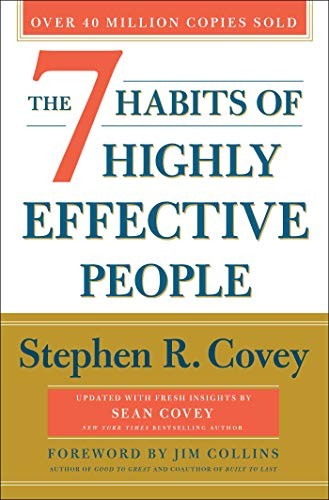
The 7 Habits of Highly Effective People
Stephen R. Covey (1989)
“Covey argues that true effectiveness begins not with techniques or tricks but with a fundamental shift in character — from dependence to independence to interdependence — and that the principles governing this shift are as immutable as the laws of physics.”
The 7 Habits of Highly Effective People— Historical Context & Author Background
Author: Stephen R. Covey · Published 1989· Era: Late 20th Century·381 pages
Themes explored: effectiveness, character, proactivity, leadership, synergy, renewal, interdependence
About Stephen R. Covey
Stephen Richards Covey was born in 1932 in Salt Lake City, Utah, and grew up in a large, closely-knit family that deeply influenced his emphasis on character, family, and principle-centered living. He earned a bachelor's degree from the University of Utah, an MBA from Harvard Business School, and a doctorate in religious education from Brigham Young University, where he subsequently joined the faculty. Covey's intellectual formation was shaped by two powerful influences: his academic training in organizational behavior and management theory, and his deep personal commitment to his Mormon faith. The combination produced a thinker who was equally comfortable with Peter Drucker's management concepts and the Sermon on the Mount, and who saw no contradiction between them. His central insight — that effectiveness requires character, and character requires principles — emerged from this fusion of secular and spiritual sources. Covey spent decades teaching organizational behavior at Brigham Young University and consulting with corporations, government agencies, and educational institutions before publishing The 7 Habits in 1989 at age fifty-six. The book drew on his academic research, his consulting experience, his family life (he and his wife Sandra raised nine children), and his personal struggle to live according to the principles he taught. Covey was open about the gap between knowing the principles and practicing them, and this honesty gave the book an authenticity that resonated with readers who were tired of self-help authors who seemed to have everything figured out. Covey died in 2012 at age seventy-nine, by which time The 7 Habits had sold over 25 million copies, been translated into 40 languages, and established Covey as one of the most influential thinkers in the history of management and personal development.
Life → Text Connections
How Stephen R. Covey's real experiences shaped specific elements of The 7 Habits of Highly Effective People.
Covey's large family (nine children)
The book's extensive use of family anecdotes to illustrate principles
Covey's family stories make abstract principles concrete and show that effectiveness is not just a professional concept but a human one — the same principles that work in the boardroom work at the dinner table
Covey's academic career at Brigham Young University
The book's philosophical depth and systematic structure
Covey's academic training gave him the intellectual framework to synthesize diverse philosophical traditions into a coherent system — a capacity that sets The 7 Habits apart from most self-help literature
Covey's Mormon faith
The emphasis on character, principles, and spiritual renewal
While the book is deliberately non-denominational, Covey's deep religious conviction that universal moral principles exist and are discoverable undergirds the entire philosophical framework
Covey's consulting work with corporations and government agencies
The practical, results-oriented focus of the habits
Covey tested his principles in demanding organizational environments before writing about them, ensuring that the habits were not just philosophically sound but practically effective
Historical Era
The Late Cold War and the Rise of Corporate Culture (1980s)
How the Era Shapes the Book
The 7 Habits was published at a moment of cultural transition — the end of the Cold War, the beginning of globalization, and a growing sense that American corporate culture needed more substance than the greed-is-good ethos of the 1980s could provide. Covey's book spoke to executives and professionals who had achieved financial success but felt a void of meaning, who had mastered technique but not character, who could manage organizations but not themselves. The book's emphasis on principle-centered living was a direct response to the moral vacuum of 1980s business culture.
Why The 7 Habits of Highly Effective People Matters Historically
The 7 Habits of Highly Effective People transformed the self-help genre by reintroducing philosophical depth and character ethics to a field that had become dominated by personality techniques and quick fixes. It is one of the best-selling nonfiction books of the twentieth century and has influenced management theory, leadership development, and personal development worldwide. Its concepts — proactivity, the Time Management Matrix, the Abundance Mentality, empathic listening, synergy — have entered the common vocabulary of business and personal development.
- Reintroduced the Character Ethic to the self-help genre after decades of Personality Ethic dominance
- Popularized the term 'proactive' in business and personal development contexts
- Created the Time Management Matrix (urgent/important) framework used worldwide
- Synthesized philosophy, psychology, and management theory into an accessible, unified system for personal effectiveness
The book has not been banned but has faced criticism from several directions. Secular critics have argued that Covey's emphasis on universal principles disguises a religiously-based (specifically Mormon) ethical framework. Management scholars have questioned whether the habits are genuinely universal or culturally specific. Some psychologists have noted that Covey's framework does not adequately address mental health conditions, trauma, or structural barriers to effectiveness.