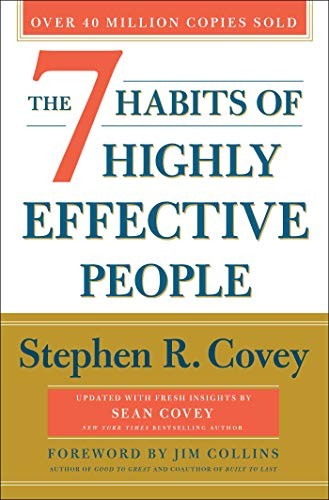
The 7 Habits of Highly Effective People
Stephen R. Covey (1989)
“Covey argues that true effectiveness begins not with techniques or tricks but with a fundamental shift in character — from dependence to independence to interdependence — and that the principles governing this shift are as immutable as the laws of physics.”
The 7 Habits of Highly Effective People— Summary & Analysis
by Stephen R. Covey · published 1989 · 381 pages · Late 20th Century
A user-friendly study guide for The 7 Habits of Highly Effective People by Stephen R. Covey (1989): a high-level plot summary, full chapter-by-chapter analysis, theme breakdowns, character profiles, and 12 essay questions designed for high-school, college readers. Unlike a stock summary, sumsumsum.com adds a diction analysis drawn from Stephen R. Covey’s actual text, and reading-difficulty guidance (Easy, 2/10) so students, teachers, and lifelong readers know what they are walking into.
“Covey argues that true effectiveness begins not with techniques or tricks but with a fundamental shift in character — from dependence to independence to interdependence — and that the principles governing this shift are as immutable as the laws of physics.”
Short Summary
Stephen Covey's landmark book presents seven habits organized along a maturity continuum from dependence to independence to interdependence. The first three habits (be proactive, begin with the end in mind, put first things first) address personal mastery; the next three (think win-win, seek first to understand, synergize) address interpersonal effectiveness; and the seventh (sharpen the saw) addresses continuous renewal. Covey argues that lasting effectiveness requires a character-based ethic grounded in universal principles, not the personality-based shortcuts of the modern self-help industry.
Detailed Summary
The 7 Habits of Highly Effective People was published in 1989, but its intellectual roots go back two centuries. Covey began his research by surveying the success literature published in the United States since 1776 and discovered a striking pattern: for the first 150 years, the literature focused o...
Chapter-by-Chapter Analysis
If you liked The 7 Habits of Highly Effective People, read next
Start with Think and Grow Rich by Napoleon Hill — Hill and Covey share the conviction that internal states (mindset for Hill, character for Covey) determine external results, but Covey replaces Hill's metaphysical claims with a more grounded philosophical framework. Then try Man's Search for Meaning by Viktor Frankl — Frankl's existential philosophy provides the intellectual foundation for Covey's concept of proactivity — the idea that between stimulus and response lies the freedom to choose. Or pivot to Atomic Habits by James Clear — Clear's habit science provides the behavioral mechanics that Covey's philosophical framework lacks — how habits are actually formed, maintained, and changed at the neurological level.
For comparative essays, pair The 7 Habits of Highly Effective People with
The strongest comparative pairing is How to Win Friends and Influence People (Dale Carnegie) — Covey explicitly builds on and critiques Carnegie's work, arguing that Carnegie's personality-based approach needs a foundation of character to produce lasting results.
Each of these pairings opens a clean thesis path on shared themes, period diction, or formal influence — useful for AP Lit / IB / first-year college comparative essays.