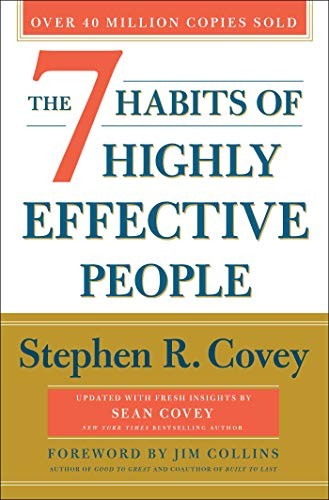
The 7 Habits of Highly Effective People
Stephen R. Covey (1989)
“Covey argues that true effectiveness begins not with techniques or tricks but with a fundamental shift in character — from dependence to independence to interdependence — and that the principles governing this shift are as immutable as the laws of physics.”
Why This Book Matters
The 7 Habits of Highly Effective People transformed the self-help genre by reintroducing philosophical depth and character ethics to a field that had become dominated by personality techniques and quick fixes. It is one of the best-selling nonfiction books of the twentieth century and has influenced management theory, leadership development, and personal development worldwide. Its concepts — proactivity, the Time Management Matrix, the Abundance Mentality, empathic listening, synergy — have entered the common vocabulary of business and personal development.
Firsts & Innovations
Reintroduced the Character Ethic to the self-help genre after decades of Personality Ethic dominance
Popularized the term 'proactive' in business and personal development contexts
Created the Time Management Matrix (urgent/important) framework used worldwide
Synthesized philosophy, psychology, and management theory into an accessible, unified system for personal effectiveness
Cultural Impact
Has sold over 25 million copies worldwide and been translated into 40 languages
Established FranklinCovey as a global training and consulting company
Influenced corporate training programs, MBA curricula, and leadership development worldwide
The concepts of 'proactive,' 'win-win,' 'synergy,' and 'paradigm shift' became standard business vocabulary partly through this book's influence
Inspired a generation of principle-based leadership books and training programs
Banned & Challenged
The book has not been banned but has faced criticism from several directions. Secular critics have argued that Covey's emphasis on universal principles disguises a religiously-based (specifically Mormon) ethical framework. Management scholars have questioned whether the habits are genuinely universal or culturally specific. Some psychologists have noted that Covey's framework does not adequately address mental health conditions, trauma, or structural barriers to effectiveness.