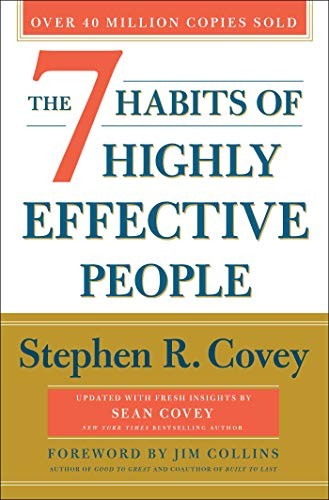
The 7 Habits of Highly Effective People
Stephen R. Covey (1989)
“Covey argues that true effectiveness begins not with techniques or tricks but with a fundamental shift in character — from dependence to independence to interdependence — and that the principles governing this shift are as immutable as the laws of physics.”
Language Register
Moderate to high. Covey uses formal vocabulary and careful sentence construction but avoids academic jargon. His paragraphs are well-organized, his arguments are logically structured, and his tone is consistently earnest and authoritative. He writes with more gravitas than Carnegie and more clarity than Hill.
Syntax Profile
Covey favors complex sentences with subordinate clauses, reflecting the nuanced relationships he describes between principles. His paragraphs typically begin with a clear topic sentence, develop through examples and qualifications, and conclude with a synthesis. The prose is more structured than Hill's and more analytical than Carnegie's — it reads like the work of a systematic thinker who values precision.
Figurative Language
Moderate. Covey's metaphors are functional rather than poetic — the sharpened saw, the emotional bank account, the ladder against the wrong wall. Each metaphor is designed to make an abstract concept concrete and memorable, and Covey rarely uses figurative language for decoration.
Era-Specific Language
A mental model or framework through which one interprets reality
Creative cooperation where the whole exceeds the sum of parts
Taking initiative and responsibility for one's own responses
How Characters Speak — Class & Identity
Covey's intended audience
Professionals, managers, and executives — people with some education and organizational responsibility
The book assumes a readership that has already achieved some degree of success and is looking for deeper effectiveness, not basic survival
Covey himself
Writes as a university professor and management consultant who has studied successful people systematically
Covey's authority is academic and professional rather than biographical — he is an observer and synthesizer rather than a self-made success story
Family anecdotes
Covey draws extensively on his experience as a father of nine children
The family examples democratize the book's principles, showing that they apply to bedtime negotiations and homework disputes as well as boardroom negotiations
Narrator's Voice
First person, reflective, and pedagogical. Covey writes as a teacher sharing a system he has developed through decades of study, teaching, and personal application. He is more self-disclosing than most business authors — willing to share his own failures and struggles — but always in service of a principle rather than for its own sake.
Tone Progression
Paradigms and Principles
Philosophical and diagnostic
Covey establishes the intellectual framework with the authority of a scholar and the urgency of a reformer
Private Victory
Systematic and instructional
The tone becomes more practical as Covey presents the tools and frameworks for personal transformation
Public Victory
Warm and relational
Covey becomes more personal and emotionally engaged as he addresses interpersonal effectiveness
Sharpen the Saw
Contemplative and integrative
The tone becomes reflective as Covey steps back to consider the habits as a unified philosophy of life
Stylistic Comparisons
- Peter Drucker — Covey shares Drucker's systematic approach to effectiveness but extends it from management to character
- Dale Carnegie — Covey explicitly critiques Carnegie's Personality Ethic while acknowledging its partial validity, offering a deeper alternative
- Viktor Frankl — Covey's concept of the space between stimulus and response is directly borrowed from Frankl's existential philosophy