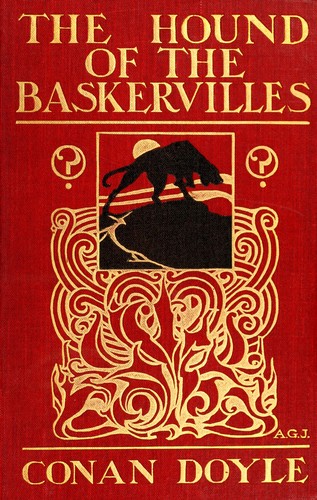
The Hound of the Baskervilles
Arthur Conan Doyle (1902)
“A spectral hound haunts an aristocratic family on the Devon moors -- and Sherlock Holmes must decide whether the danger is supernatural or terrifyingly human.”
At a Glance
Dr. Mortimer brings Sherlock Holmes a centuries-old legend: a demonic hound has cursed the Baskerville family since 1742, and the latest baronet, Sir Charles, has just died of apparent fright on the moor. Holmes sends Watson to guard the new heir, Sir Henry Baskerville, at Baskerville Hall in Devon. Watson encounters escaped convicts, mysterious figures on the tor, and a naturalist named Stapleton who seems too interested in the family. Holmes has been secretly observing from the moor the entire time. The hound turns out to be a real dog, coated in phosphorus, deployed by Stapleton -- who is himself a secret Baskerville heir plotting to inherit the estate. Holmes shoots the hound, Stapleton flees into the Grimpen Mire and is swallowed by the bog. Reason defeats superstition, but the moor keeps its secrets.
Read full summary →Why This Book Matters
The Hound of the Baskervilles is the most famous detective novel in the English language and the work that cemented Sherlock Holmes as a permanent cultural figure. Published serially in The Strand Magazine from August 1901 to April 1902, it was so anticipated that queues formed at newsstands for each installment. It proved that Holmes was commercially irreplaceable and led directly to Doyle's full resurrection of the character in 1903. More significantly, it is the first major detective novel to fuse the Gothic horror tradition with the rationalist detective tradition -- proving that the two modes could coexist and that the detective story could sustain novel-length narrative, not just short stories.
Diction Profile
Formal Victorian prose with medical precision in Watson's narration, shifting to Gothic atmospherics on the moor
Moderate in Baker Street scenes, very high on the moor. The moor generates persistent pathetic fallacy -- fog as concealment, granite as permanence, the Mire as moral corruption. Doyle restrains figurative language in Holmes' dialogue (rationalism resists metaphor) but allows Watson's narration to become genuinely literary when the Gothic atmosphere demands it.