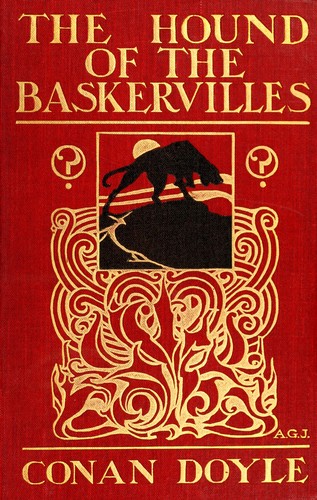
The Hound of the Baskervilles
Arthur Conan Doyle (1902)
“A spectral hound haunts an aristocratic family on the Devon moors -- and Sherlock Holmes must decide whether the danger is supernatural or terrifyingly human.”
The Hound of the Baskervilles— Summary & Analysis
by Arthur Conan Doyle · published 1902 · 256 pages · Victorian / Detective Fiction
A user-friendly study guide for The Hound of the Baskervilles by Arthur Conan Doyle (1902): a high-level plot summary, full chapter-by-chapter analysis, theme breakdowns, character profiles, and 30 essay questions designed for middle-school, high-school, ap-english readers. Unlike a stock summary, sumsumsum.com adds a diction analysis drawn from Arthur Conan Doyle’s actual text, the 2 documented AP Literature exam appearances of this book, and reading-difficulty guidance (Easy, 2/10) so students, teachers, and lifelong readers know what they are walking into.
“A spectral hound haunts an aristocratic family on the Devon moors -- and Sherlock Holmes must decide whether the danger is supernatural or terrifyingly human.”
Short Summary
Dr. Mortimer brings Sherlock Holmes a centuries-old legend: a demonic hound has cursed the Baskerville family since 1742, and the latest baronet, Sir Charles, has just died of apparent fright on the moor. Holmes sends Watson to guard the new heir, Sir Henry Baskerville, at Baskerville Hall in Devon. Watson encounters escaped convicts, mysterious figures on the tor, and a naturalist named Stapleton who seems too interested in the family. Holmes has been secretly observing from the moor the entire time. The hound turns out to be a real dog, coated in phosphorus, deployed by Stapleton -- who is himself a secret Baskerville heir plotting to inherit the estate. Holmes shoots the hound, Stapleton flees into the Grimpen Mire and is swallowed by the bog. Reason defeats superstition, but the moor keeps its secrets.
Detailed Summary
The novel opens in Baker Street, where Dr. James Mortimer presents Holmes and Watson with a manuscript describing the Baskerville curse: in 1742, the wicked Hugo Baskerville pursued a kidnapped maiden across the moor and was found dead, his throat torn out by a gigantic spectral hound. Since then, t...
Summary in the Author’s Writing Style
A retelling of The Hound of the Baskervilles in Arthur Conan Doyle’s style — so you can hear the language, not just the plot. This is a stylistic pastiche written by sumsumsum, not an excerpt from the book.
It was upon a raw morning in Baker Street that Dr. James Mortimer laid before us a yellowed manuscript and a problem in equal measure. The paper bore a legend out of 1742: how the profligate Hugo Baskerville had hunted a frightened maiden across the moor by night, and how he had been found upon the …
Chapter-by-Chapter Analysis
If you liked The Hound of the Baskervilles, read next
Start with The Moonstone by Wilkie Collins — The first English detective novel (1868) -- multiple narrators, a cursed gem, and landscape (the Shivering Sand) as moral force. Doyle inherited Collins' architecture.. Then try And Then There Were None by Agatha Christie — Christie's island mystery owes a direct debt to Doyle's moor -- isolated setting, accumulating dread, and a killer hiding in plain sight among the characters.. Or pivot to The Name of the Rose by Umberto Eco — A medieval Holmes (William of Baskerville -- the name is deliberate) investigates murders in a monastery. Eco's homage explores the same tension between reason and faith..
For comparative essays, pair The Hound of the Baskervilles with
The strongest comparative pairing is Dracula (Bram Stoker) — Published five years earlier (1897), Dracula is the Gothic novel that The Hound responds to -- same rational-vs-supernatural tension, but Stoker lets the supernatural win. For a third angle, contrast with The Turn of the Screw (Henry James) — Published 1898 -- another Victorian Gothic where the reader must decide: supernatural or psychological? James refuses to answer. Doyle answers definitively. Compare the two approaches..
Each of these pairings opens a clean thesis path on shared themes, period diction, or formal influence — useful for AP Lit / IB / first-year college comparative essays.