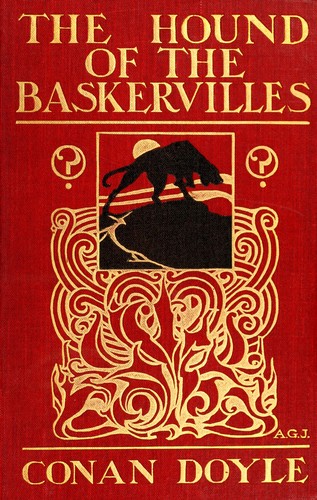
The Hound of the Baskervilles
Arthur Conan Doyle (1902)
“A spectral hound haunts an aristocratic family on the Devon moors -- and Sherlock Holmes must decide whether the danger is supernatural or terrifyingly human.”
Essay Questions & Food for Thought
30questions designed to challenge assumptions and provoke original thinking. These can't be answered from a summary — you need the actual text.
Why does Doyle remove Holmes from the middle of the novel and make Watson the sole investigator on the moor? What does the reader gain -- and lose -- from experiencing the mystery through Watson's more limited perspective?
The moor is often described as a 'character' in the novel. How does Doyle use the Dartmoor landscape to undermine rational certainty? Find three specific passages where the moor's atmosphere works against Holmes' method.
Holmes deceives Watson for weeks, letting him believe Holmes is in London while secretly living on the moor. Is this a betrayal of friendship or a necessary tactical decision? Does the novel take a position?
Stapleton disguises himself as a naturalist -- a man who classifies and catalogs nature. How does this disguise comment on the relationship between Victorian science and Victorian violence?
When the phosphorescent hound finally appears, even Holmes freezes momentarily. Why does Doyle include this detail? What does it mean that the arch-rationalist is briefly paralyzed by the thing he knows is fake?
Selden the convict dies wearing Sir Henry's clothes and is mourned by almost no one. How does the novel's treatment of Selden's death reveal its class assumptions? Would a modern novel handle this differently?
Beryl Stapleton warns Sir Henry to leave, sends the newspaper-clipping letter, and is found bound and beaten after the climax. Why does the novel not give her more agency or voice? Is she a character or a function?
Compare the Baskerville legend (Hugo's sin, the spectral hound) to the actual plot (Stapleton's inheritance scheme). In what ways is the 'real' explanation more disturbing than the supernatural one?
Holmes says 'The world is full of obvious things which nobody by any chance ever observes.' Apply this principle to your own life. What 'obvious things' do people systematically ignore in social media, politics, or personal relationships?
Doyle wrote The Hound five years after killing Holmes at Reichenbach Falls. How does knowing that Doyle resented Holmes and was pressured to bring him back change your reading of the novel's structure -- especially Holmes' absence from the middle chapters?
Watson attempts his own deductions at the beginning of the novel and gets them mostly wrong. Is Watson stupid, or is Doyle making a point about the difference between observation and deduction?
The stolen boot subplot is the key to the entire mystery (it provides the hound's scent), yet it seems trivial when it happens. How does Doyle hide the solution in plain sight? What techniques does he use to distract the reader?
The Grimpen Mire swallows Stapleton at the end. No trial, no punishment, no justice system. Is the moor's 'natural justice' more satisfying than a courtroom verdict would have been? Why or why not?
Laura Lyons is manipulated by Stapleton through false promises of marriage. How does the Victorian class system create the conditions for her exploitation? Could a modern Laura Lyons be manipulated the same way?
Doyle later became a passionate believer in Spiritualism, defending the existence of ghosts and fairies. How does knowing about Doyle's later beliefs change your reading of the novel's treatment of the supernatural?
Holmes uses Sir Henry as bait in the climax -- sending him to walk alone across the moor knowing the hound will attack. Is this ethical? Holmes calculates that he can intervene in time, but the fog nearly prevents it. Does the end justify the means?
The novel opens and closes in Baker Street, with the moor as the dangerous middle. How does this geographical structure mirror the novel's argument about rationalism and the Gothic?
Compare Stapleton's use of technology (phosphorescent paint, scent tracking) with the 'supernatural' explanation the legend provides. How does the novel argue that science can be more dangerous than superstition?
Watson's prose style changes dramatically between London and the moor -- shorter and more analytical in Baker Street, longer and more atmospheric in Devon. Find specific examples of this shift. What does it suggest about the moor's effect on rational thinking?
The Hound of the Baskervilles has been adapted over 25 times for film and television. Why does this story translate so well to visual media? What does the novel have that other Holmes stories lack?
Doyle based Holmes' deductive method on Dr. Joseph Bell, his Edinburgh medical professor. How is Holmes' investigation of the Baskerville case essentially a medical diagnosis? What is the 'disease' and what is the 'cure'?
The Baskerville 'curse' turns out to be inheritance law -- Stapleton murders to claim the estate. How does the novel suggest that the English class system itself is the real curse?
Holmes says 'The more outre and grotesque an incident is, the more carefully it deserves to be examined.' Apply this principle to a current conspiracy theory or viral hoax. How would Holmes approach modern misinformation?
Why does Doyle make Stapleton a naturalist specifically -- not a doctor, lawyer, or businessman? How does the naturalist disguise connect to the novel's themes about science, nature, and control?
Compare The Hound of the Baskervilles to a modern detective show (Sherlock, True Detective, Mare of Easttown). How has the relationship between setting and mystery evolved since 1902? What did Doyle pioneer that these shows still use?
The novel never shows us Stapleton's perspective. We learn his plan only through Holmes' retrospective explanation. How would the novel change if we had chapters from Stapleton's point of view? Would it be better or worse?
Fog is the novel's most important weather element -- it nearly ruins Holmes' trap in the climax. How does Doyle use fog throughout the novel as both a physical obstacle and a metaphor for the limits of knowledge?
Sir Henry's nerves are shattered after the case -- his hair turns grey overnight, and he needs months of travel to recover. Holmes, by contrast, is unaffected. What does this difference say about the cost of courage versus the cost of certainty?
Read Watson's description of the moor aloud: 'Over the green squares of the fields and the low curve of a wood there rose in the distance a gray, melancholy hill, with a strange jagged summit.' How does the rhythm and sound of the language create the moor's emotional effect?
Doyle said he 'got on to the idea' for the novel from friend Bertram Fletcher Robinson's tales of Dartmoor folklore. If the novel is rooted in real local legend, does that make its rationalist ending more or less convincing? Does real folklore deserve debunking?