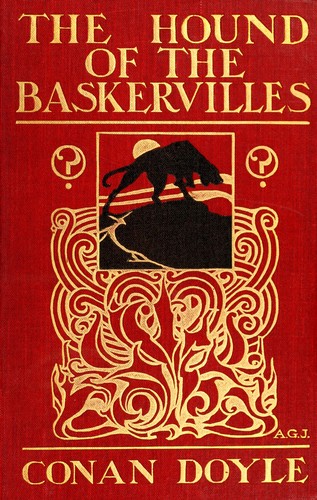
The Hound of the Baskervilles
Arthur Conan Doyle (1902)
“A spectral hound haunts an aristocratic family on the Devon moors -- and Sherlock Holmes must decide whether the danger is supernatural or terrifyingly human.”
Language Register
Formal Victorian prose with medical precision in Watson's narration, shifting to Gothic atmospherics on the moor
Syntax Profile
Watson's sentences average 18-22 words in London scenes but expand to 30+ on the moor, accumulating subordinate clauses that mirror the landscape's complexity. Holmes' dialogue is characteristically crisp: short declarative sentences, rhetorical questions, and the occasional epigram. Stapleton speaks in the measured periods of an educated naturalist -- his syntax is a disguise as carefully maintained as his false name.
Figurative Language
Moderate in Baker Street scenes, very high on the moor. The moor generates persistent pathetic fallacy -- fog as concealment, granite as permanence, the Mire as moral corruption. Doyle restrains figurative language in Holmes' dialogue (rationalism resists metaphor) but allows Watson's narration to become genuinely literary when the Gothic atmosphere demands it.
Era-Specific Language
Open, uncultivated upland -- both geographic feature and psychological landscape of isolation
Hereditary title, the rank below baron -- marks the Baskervilles as landed gentry, not nobility
Escaped prisoner from Princetown (Dartmoor Prison) -- Victorian criminal underclass made visible
Treacherous bog -- literal death trap and metaphor for the inescapable past
Not used here -- but compare Gatsby. Doyle's equivalent class marker is 'Sir Henry' vs. 'Mr. Stapleton' -- title as social GPS
The path where Sir Charles died -- yew trees traditionally associated with death and churchyards
How Characters Speak — Class & Identity
Sherlock Holmes
Precise, analytical, epigrammatic. Avoids emotional vocabulary. Uses scientific and legal terminology. Commands through certainty rather than authority.
Holmes' language performs expertise rather than class. He belongs to no social stratum -- he belongs to the domain of pure reason, which is classless.
Dr. Watson
Formal Victorian medical register -- 'I observed,' 'it was evident,' 'the facts were as follows.' Becomes more atmospheric and literary under the moor's influence.
Watson is professional middle-class: educated, respectable, deferential to titles. His language is competent but never brilliant -- the honest prose of a reliable witness.
Sir Henry Baskerville
Plain, direct, colonial English. Shorter sentences than any English character. Minimal hedging or qualification.
Canadian frontier has stripped the aristocratic register from his speech. He has the title but not the manner -- which is precisely why the English class system cannot protect him.
Jack Stapleton
Enthusiastic naturalist vocabulary, Latin species names, educated warmth. The register of a gentleman scholar.
Stapleton's language is his primary disguise. He speaks like a harmless eccentric, not like a Baskerville. His real register -- cold, controlling, aristocratic -- emerges only with Beryl.
Barrymore / Mrs. Barrymore
Respectful servant English -- 'sir,' 'if you please,' indirect phrasing. Mrs. Barrymore's speech breaks down into raw emotion when Selden is discussed.
The servant class speaks in the language of deference, concealing their actual loyalties (to Selden, to family) behind the grammar of obedience.
Narrator's Voice
Watson: first-person retrospective, medically trained, emotionally generous, analytically limited. He records evidence with a doctor's precision and interprets it with a friend's loyalty. His most significant trait as a narrator is that he sees everything and understands about sixty percent of it -- the gap between observation and comprehension is where the suspense lives.
Tone Progression
Chapters 1-4
Analytical, brisk, London-confident
Baker Street operates. Holmes deduces. Watson assists. The world is knowable and evidence-based.
Chapters 5-9
Gothic, uneasy, increasingly isolated
The moor takes over. Watson is alone. The language loosens, lengthens, becomes atmospheric. Certainty dissolves into fog.
Chapters 10-13
Tense, accelerating, violent
Holmes returns. The pace tightens. Gothic atmosphere collides with rational plan. The climax is both terrifying and mechanical.
Chapters 14-15
Explanatory, warm, residually uneasy
Baker Street restores order. Every question is answered. But Watson's prose carries a residual tremor, as if the moor is not quite finished.
Stylistic Comparisons
- Wilkie Collins -- The Moonstone: another detective novel where landscape (the Shivering Sand) is a moral force
- Bram Stoker -- Dracula: contemporary Gothic with similar rational-vs-supernatural tension, but Stoker lets the supernatural win
- Edgar Allan Poe -- The Murders in the Rue Morgue: the original detective story, but Poe keeps the Gothic and the rational in separate rooms; Doyle forces them to share the moor
Key Vocabulary from This Book
Notable words used in this text — click to see full definitions