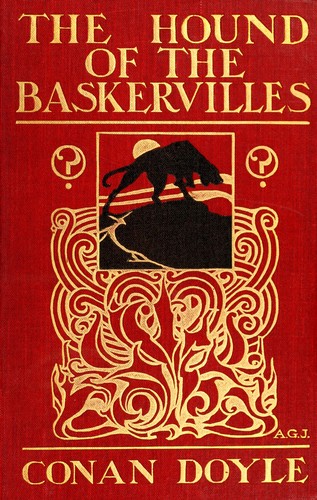
The Hound of the Baskervilles
Arthur Conan Doyle (1902)
“A spectral hound haunts an aristocratic family on the Devon moors -- and Sherlock Holmes must decide whether the danger is supernatural or terrifyingly human.”
The Hound of the Baskervilles— Historical Context & Author Background
Author: Arthur Conan Doyle · Published 1902· Era: Victorian / Detective Fiction·256 pages
Themes explored: rationalism-vs-superstition, class, deception, gothic-horror, science, moor-as-landscape
About Arthur Conan Doyle
Arthur Conan Doyle (1859-1930) was a Scottish physician who created Sherlock Holmes in 1887 and spent the rest of his life regretting it. He considered Holmes a distraction from his 'serious' historical novels (The White Company, Sir Nigel) and killed Holmes at Reichenbach Falls in 1893. Public outrage was extraordinary -- 20,000 subscribers cancelled their Strand Magazine subscriptions, and readers wore black armbands in mourning. Doyle resisted for eight years, then wrote The Hound of the Baskervilles in 1901 as a compromise: a Holmes story set before Reichenbach, technically not a resurrection. The novel's success made the full resurrection inevitable (1903). Doyle spent his later years as a passionate advocate for Spiritualism -- the man who created fiction's greatest rationalist became a true believer in ghosts, seances, and fairies. He defended the Cottingley Fairies photographs as genuine. The contradiction is the man.
Life → Text Connections
How Arthur Conan Doyle's real experiences shaped specific elements of The Hound of the Baskervilles.
Doyle was trained as a physician at Edinburgh under Dr. Joseph Bell, whose diagnostic method -- observing patients' hands, clothing, and gait to deduce their occupation and habits -- became the basis for Holmes' deductive method
Holmes' reading of Mortimer's walking stick, the stolen boots as scent evidence, the systematic reduction of every supernatural element to material cause
The Holmes method is medical diagnosis applied to crime. Doyle's scientific training is the foundation of everything Holmes does -- and the novel's insistence that every effect has a natural cause is a physician's worldview.
Doyle killed Holmes in 1893 and wrote The Hound in 1901 under enormous pressure from readers and his publisher -- he needed money and the public demanded Holmes
Holmes' absence from the middle third of the novel and his dramatic re-emergence on the moor
The structural experiment -- removing Holmes from his own story -- reflects Doyle's ambivalence about the character. He wanted to write without Holmes but couldn't sell without him. The novel's solution is elegant: Holmes is present but invisible, controlling the narrative from hiding.
Doyle became a fervent Spiritualist after WWI, believing he could communicate with his dead son Kingsley through seances
The novel's treatment of the supernatural as something that is definitively debunked yet atmospherically potent -- the Gothic is false but the fear is real
The Hound captures Doyle at a turning point. In 1901 he was still a rationalist, but the pull of the irrational is already visible in how seriously the novel takes the moor's atmosphere. The man who would later believe in fairies wrote a novel where superstition is defeated by reason -- but not comfortably.
Doyle co-wrote the original Hound plot with his friend Bertram Fletcher Robinson, who suggested the Dartmoor legend of a spectral hound
The Baskerville legend, the Dartmoor setting, the Grimpen Mire (based on Fox Tor Mire)
The novel's power comes from its rooting in real landscape and local folklore. Doyle visited Dartmoor with Robinson and absorbed the geography. The moor in the novel is not invented -- it is transcribed, which is why it feels so oppressively real.
Historical Era
Late Victorian England -- 1889 (setting), 1901-1902 (publication)
How the Era Shapes the Book
The novel is a product of late Victorian anxieties about rationalism's limits. The British Empire was built on the belief that science and reason could master any environment -- and Dartmoor, a landscape within England itself, defied that mastery. The Baskerville curse embodies the fear that heredity (the dark side of Darwin) determines fate regardless of individual virtue. Stapleton's disguise as a naturalist weaponizes Victorian science itself -- the man who classifies butterflies is the man who breeds a killer dog. The class system drives the entire plot: inheritance law is the motive, primogeniture is the mechanism, and the moor -- common land, ungovernable, pre-civilized -- is the space where class pretensions dissolve into survival.
Why The Hound of the Baskervilles Matters Historically
The Hound of the Baskervilles is the most famous detective novel in the English language and the work that cemented Sherlock Holmes as a permanent cultural figure. Published serially in The Strand Magazine from August 1901 to April 1902, it was so anticipated that queues formed at newsstands for each installment. It proved that Holmes was commercially irreplaceable and led directly to Doyle's full resurrection of the character in 1903. More significantly, it is the first major detective novel to fuse the Gothic horror tradition with the rationalist detective tradition -- proving that the two modes could coexist and that the detective story could sustain novel-length narrative, not just short stories.
- The first Holmes story to sustain genuine novel-length narrative tension (earlier novels like A Study in Scarlet split into separate storylines)
- One of the first detective novels to make landscape a central character rather than a backdrop
- Pioneered the structural experiment of removing the detective from the middle of his own story, forcing the reader to share the sidekick's limitations
Rarely banned or challenged, though some school districts have questioned its suitability for younger readers due to violence (Selden's death, the hound's attack) and the novel's genuinely frightening atmosphere. Occasionally challenged by religious groups for its treatment of superstition -- ironically, both for taking the supernatural too seriously and for dismissing it too readily.