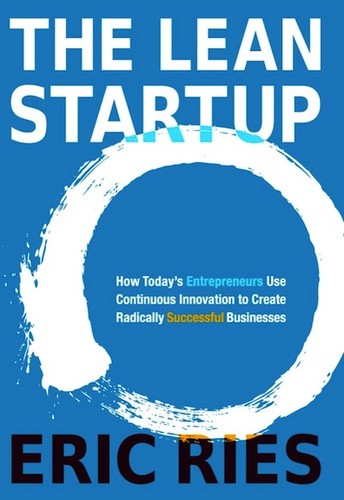
The Lean Startup
Eric Ries (2011)
“A Silicon Valley entrepreneur argues that startups are not smaller versions of large companies — they are experiments, and the ones that succeed are those that learn fastest what customers actually want.”
The Lean Startup— Historical Context & Author Background
Author: Eric Ries · Published 2011· Era: Contemporary Nonfiction·336 pages
Themes explored: innovation, experimentation, validated-learning, pivot, minimum-viable-product, entrepreneurship
About Eric Ries
Eric Ries (born 1978) is an American entrepreneur, blogger, and author who cofounded IMVU, a 3D avatar-based social network, in 2004. The experience of building IMVU — particularly the painful discovery that many of the product decisions were based on untested assumptions — became the foundation for the lean startup methodology. Ries studied computer science at Yale and was influenced by the Toyota Production System, agile software development, and Steve Blank's customer development model. He began blogging about his emerging methodology in 2008 under the name 'Startup Lessons Learned,' and the blog quickly attracted a following among entrepreneurs and venture capitalists who recognized the problems he was describing. The Lean Startup, published in 2011, synthesized years of blog posts, conference talks, and consulting experience into a coherent framework. It became a New York Times bestseller and spawned a global movement — Lean Startup meetups in over 100 cities, corporate adoption programs at GE and other Fortune 500 companies, and a conference series that drew thousands of attendees. Ries subsequently founded the Long-Term Stock Exchange (LTSE), which received SEC approval in 2019, as a market designed to encourage long-term thinking over short-term financial engineering. This venture reflects his belief that the problems the lean startup addresses — the misallocation of resources under uncertainty — are not limited to startups but are systemic features of modern capitalism.
Life → Text Connections
How Eric Ries's real experiences shaped specific elements of The Lean Startup.
IMVU's failed interoperability feature — months of work on something users didn't want
The IMVU story opens the book and illustrates the core problem the lean startup solves
Ries's personal failure gives the methodology emotional authenticity — he is not theorizing about problems he hasn't experienced
Steve Blank's mentorship and customer development model
Blank's framework is explicitly credited as a predecessor to the lean startup
Ries positions himself within an intellectual lineage, giving the methodology academic as well as practical credibility
Background in software engineering at Yale
The book's emphasis on iteration, experimentation, and rapid deployment reflects software development practices
The lean startup methodology is shaped by software's unique properties — low marginal cost, easy iteration, rapid deployment — which may limit its applicability to other industries
Historical Era
Post-2008 startup boom and the rise of Silicon Valley as cultural paradigm
How the Era Shapes the Book
The Lean Startup emerged at a moment when starting a software company had never been cheaper or easier, but the failure rate remained stubbornly high. The 2008 financial crisis had discredited elaborate long-range planning, creating an intellectual opening for a methodology that emphasized adaptation over prediction. Cloud computing and mobile platforms meant that entrepreneurs could build and iterate on products at minimal cost, making rapid experimentation practical in a way that would have been impossible a decade earlier. The book both reflected and accelerated a cultural shift in Silicon Valley from the 'stealth mode' approach (build in secret, launch big) to the 'launch and learn' approach that became the dominant startup methodology of the 2010s.
Why The Lean Startup Matters Historically
The Lean Startup transformed how entrepreneurs, investors, and organizations think about innovation. It provided a common vocabulary (MVP, pivot, validated learning) and a systematic methodology for reducing the waste inherent in building new products under uncertainty. Its influence extends far beyond Silicon Valley into corporate innovation, government, education, and nonprofit sectors.
- Systematized the concept of the Minimum Viable Product as a learning tool rather than a product strategy
- Introduced 'innovation accounting' as a framework for measuring startup progress
- Popularized the concept of the 'pivot' as a structured strategic change rather than a failure or a whim
- Applied lean manufacturing principles to knowledge work and entrepreneurship in a comprehensive framework
Not banned, but the methodology has been criticized on several fronts: that it overemphasizes customer feedback at the expense of visionary products (Steve Jobs famously did not rely on customer research), that the MVP concept can be used to justify shipping low-quality products, that the framework works better for consumer software than for deep technology or hardware, and that the emphasis on speed and iteration can produce a culture of shallow optimization rather than genuine innovation.