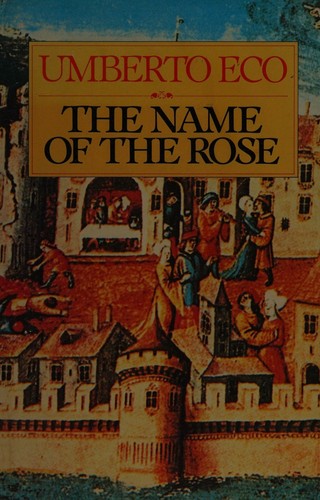
The Name of the Rose
Umberto Eco (1980)
“A medieval murder mystery that uses a monastery's burning library to ask whether knowledge should be controlled — written by the man who invented modern semiotics.”
At a Glance
In 1327, the Franciscan friar William of Baskerville and his novice Adso of Melk arrive at a wealthy Benedictine abbey in northern Italy to prepare for a theological debate. Seven monks die in seven days, each death linked to a forbidden book — Aristotle's lost second volume of the Poetics, on comedy and laughter. William unravels the labyrinthine library's secrets and identifies Jorge of Burgos, a blind elder monk, as the killer. Jorge has poisoned the book's pages to prevent anyone from reading Aristotle's defense of laughter, which he believes would undermine the authority of the Church. In the final confrontation, Jorge eats the poisoned pages and sets the library ablaze. The greatest collection of knowledge in Christendom burns to ash. Adso narrates the story decades later, an old man who has learned that the pursuit of signs leads only to more signs, never to final truth.
Read full summary →Why This Book Matters
The Name of the Rose proved that a novel drenched in medieval philosophy, Scholastic theology, and semiotic theory could become a global bestseller. It sold over fifty million copies and single-handedly created the genre of the 'intellectual thriller' — a detective story whose real mystery is epistemological. Before Eco, the assumption was that literary theory and popular fiction were incompatible. After Eco, that assumption was permanently retired.
Diction Profile
Highly formal — Latinate syntax, medieval scholastic cadences, embedded in a frame of scholarly apparatus (prefaces, footnotes to the fictional manuscript)
Moderate in surface metaphor but saturated in structural allegory. The library IS a labyrinth. The book IS a weapon. The fire IS an apocalypse. Eco prefers allegory and symbol over simile