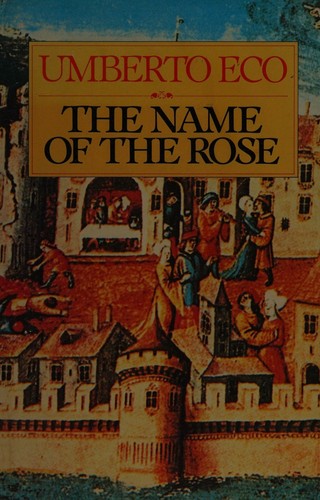
The Name of the Rose
Umberto Eco (1980)
“A medieval murder mystery that uses a monastery's burning library to ask whether knowledge should be controlled — written by the man who invented modern semiotics.”
The Name of the Rose— Historical Context & Author Background
Author: Umberto Eco · Published 1980· Era: Postmodern·536 pages
Themes explored: knowledge, censorship, semiotics, laughter, heresy, labyrinth, truth, books
About Umberto Eco
Umberto Eco (1932-2016) was an Italian semiotician, medievalist, literary critic, and philosopher who became the most commercially successful academic novelist of the twentieth century. He held the chair of semiotics at the University of Bologna for decades, published landmark academic works including A Theory of Semiotics (1976) and The Role of the Reader (1979), and only turned to fiction at age forty-eight. The Name of the Rose (1980) was his first novel. It sold over fifty million copies worldwide and was translated into more than forty languages — an unprecedented achievement for a book saturated with medieval Latin, Scholastic philosophy, and semiotic theory. Eco described the novel as a book 'in which the reader would find what he brings' — a detective plot for thriller readers, a philosophical argument for intellectuals, a historical panorama for medievalists.
Life → Text Connections
How Umberto Eco's real experiences shaped specific elements of The Name of the Rose.
Eco's doctoral thesis was on the aesthetics of Thomas Aquinas, and he spent decades studying medieval sign theory
The novel's entire plot turns on the interpretation of signs — hoofprints, inscriptions, marginal illustrations, coded manuscripts
The detective plot IS semiotics in action. Eco did not adapt his academic work into fiction; he dramatized it. William's investigation is a semiotic analysis of a medieval sign system.
Eco was a leading theorist of the 'open work' — texts that invite multiple interpretations rather than imposing a single meaning
The novel deliberately supports multiple readings: as detective fiction, as medieval history, as semiotic theory, as a critique of censorship, as a Borgesian metafiction
The Name of the Rose is Eco's 'open work' par excellence. Its structural openness is not accidental but the fictional enactment of his academic theory.
Eco was a passionate bibliophile who owned over 30,000 books and wrote extensively about the culture of the book
The library is the novel's sacred and contested space — the place where knowledge is simultaneously preserved and imprisoned
Eco's love of books and his understanding of their institutional politics are inseparable. The burning library is the bibliophile's nightmare rendered as narrative.
Eco explicitly acknowledged Jorge Luis Borges as a primary influence and named Jorge of Burgos after him
A blind librarian named Jorge who presides over a labyrinthine library — the Borges homage is the novel's most visible intertextual gesture
The homage is also a critique. Borges's labyrinths are metaphysical playgrounds; Eco's labyrinth is a political instrument. The blind librarian in Borges is a figure of poignant irony; in Eco, he is an agent of destruction.
Historical Era
1327 — Avignon papacy, Franciscan poverty controversy, early fourteenth-century Italy
How the Era Shapes the Book
The fourteenth century was the hinge between the medieval and the modern — the last century in which the Church could plausibly claim a monopoly on knowledge. Eco chose 1327 precisely because it was a moment when that monopoly was under maximum stress: the Franciscan poverty debate challenged the Church's wealth, Ockham's empiricism challenged its epistemology, and the Avignon captivity challenged its political independence. The abbey's burning library is a symbol for the entire medieval knowledge system beginning to crack — not from external assault but from internal contradictions.
Why The Name of the Rose Matters Historically
The Name of the Rose proved that a novel drenched in medieval philosophy, Scholastic theology, and semiotic theory could become a global bestseller. It sold over fifty million copies and single-handedly created the genre of the 'intellectual thriller' — a detective story whose real mystery is epistemological. Before Eco, the assumption was that literary theory and popular fiction were incompatible. After Eco, that assumption was permanently retired.
- First novel to successfully dramatize semiotic theory as a detective plot — proving that academic philosophy could drive a page-turning narrative
- Pioneered the 'postmodern historical novel' — fiction that reconstructs a historical period while simultaneously interrogating the impossibility of historical reconstruction
- Created the template for the 'intellectual thriller' that Dan Brown, Arturo Perez-Reverte, and dozens of others would follow
Not formally banned, but challenged in some Catholic educational contexts for its depictions of monastic sexual activity, its unflattering portrait of the medieval Inquisition, and its suggestion that the Church systematically suppressed knowledge. The novel's treatment of heresy as a legitimate intellectual position rather than a moral failing made it controversial in conservative religious circles.