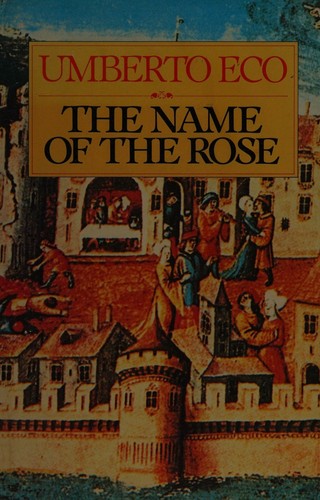
The Name of the Rose
Umberto Eco (1980)
“A medieval murder mystery that uses a monastery's burning library to ask whether knowledge should be controlled — written by the man who invented modern semiotics.”
This page prints on a single page. Use Ctrl+P / Cmd+P.
The Name of the Rose
Umberto Eco (1980) · 536pages · Postmodern · 3 AP appearances
Summary
In 1327, the Franciscan friar William of Baskerville and his novice Adso of Melk arrive at a wealthy Benedictine abbey in northern Italy to prepare for a theological debate. Seven monks die in seven days, each death linked to a forbidden book — Aristotle's lost second volume of the Poetics, on comedy and laughter. William unravels the labyrinthine library's secrets and identifies Jorge of Burgos, a blind elder monk, as the killer. Jorge has poisoned the book's pages to prevent anyone from reading Aristotle's defense of laughter, which he believes would undermine the authority of the Church. In the final confrontation, Jorge eats the poisoned pages and sets the library ablaze. The greatest collection of knowledge in Christendom burns to ash. Adso narrates the story decades later, an old man who has learned that the pursuit of signs leads only to more signs, never to final truth.
Why It Matters
The Name of the Rose proved that a novel drenched in medieval philosophy, Scholastic theology, and semiotic theory could become a global bestseller. It sold over fifty million copies and single-handedly created the genre of the 'intellectual thriller' — a detective story whose real mystery is epi...
Themes & Motifs
Diction & Style
Register: Highly formal — Latinate syntax, medieval scholastic cadences, embedded in a frame of scholarly apparatus (prefaces, footnotes to the fictional manuscript)
Narrator: Adso of Melk, narrating in extreme old age, looking back on events of his youth. The double temporal perspective — yo...
Figurative Language: Moderate in surface metaphor but saturated in structural allegory. The library IS a labyrinth. The book IS a weapon. The fire IS an apocalypse. Eco prefers allegory and symbol over simile
Historical Context
1327 — Avignon papacy, Franciscan poverty controversy, early fourteenth-century Italy: The fourteenth century was the hinge between the medieval and the modern — the last century in which the Church could plausibly claim a monopoly on knowledge. Eco chose 1327 precisely because it wa...
Key Characters
Talking Points
- Eco named his protagonist 'William of Baskerville' — after both William of Ockham and Conan Doyle's Hound of the Baskervilles. What does this double reference tell us about the kind of detective William is, and about how Eco's novel relates to the detective genre?
- Jorge of Burgos is transparently named after Jorge Luis Borges — the blind Argentine librarian who wrote about labyrinths and infinite libraries. Why does Eco turn his literary hero into his villain? What is the critique embedded in the homage?
- The murder weapon in this novel is a book — Aristotle's lost treatise on comedy, whose pages are poisoned. Why is this the most thematically perfect murder weapon Eco could have chosen?
- William solves the mystery but fails to prevent the library from burning. What is Eco saying about the relationship between knowledge and power — specifically, about whether understanding a system is sufficient to save it?
- Jorge argues that if Aristotle validates laughter as a philosophical tool, the Church's authority will collapse because it rests on fear. Is he wrong? What is the relationship between laughter and institutional power?
Notable Quotes
“Books are not made to be believed, but to be subjected to inquiry.”
“The good of a book lies in its being read. A book is made up of signs that speak of other signs, which in their turn speak of things.”
“Laughter is weakness, corruption, the foolishness of our flesh.”
Why Read This
Because this is the rare novel that makes you smarter for having read it — not in a medicinal, eat-your-vegetables way, but because its central mystery is genuinely exciting and its resolution genuinely disturbing. You will learn how medieval monk...