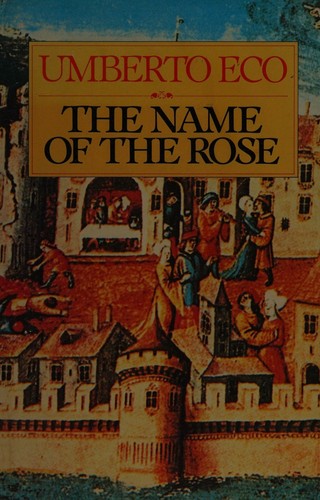
The Name of the Rose
Umberto Eco (1980)
“A medieval murder mystery that uses a monastery's burning library to ask whether knowledge should be controlled — written by the man who invented modern semiotics.”
Language Register
Highly formal — Latinate syntax, medieval scholastic cadences, embedded in a frame of scholarly apparatus (prefaces, footnotes to the fictional manuscript)
Syntax Profile
Extremely long sentences with multiple subordinate clauses, parenthetical digressions, and embedded quotations from Latin sources. Adso's narration mimics medieval chronicle style — cataloguing, listing, circling back. Eco averages 30-40 words per sentence in descriptive passages, with some sentences exceeding 100 words. The syntax itself is a labyrinth.
Figurative Language
Moderate in surface metaphor but saturated in structural allegory. The library IS a labyrinth. The book IS a weapon. The fire IS an apocalypse. Eco prefers allegory and symbol over simile — his figures operate at the architectural level rather than the sentence level.
Era-Specific Language
Formal scholastic debate between theological positions — the dominant mode of medieval intellectual life
The secret room at the end of the African section of the library — the novel's locked room
Aristotle — referred to by medieval scholars not by name but by supreme title, indicating unmatched authority
The buying and selling of ecclesiastical privileges — one of many period-specific ecclesiastical crimes
Decorative and often grotesque drawings in manuscript margins — the site of medieval visual comedy
How Characters Speak — Class & Identity
William of Baskerville
Precise, Latinate, logically structured. Uses Ockhamist philosophical vocabulary. Alternates between deductive exposition and Socratic questioning.
The educated Franciscan intellectual — rationalist, empiricist, comfortable with uncertainty. His language embodies the via moderna of fourteenth-century philosophy.
Jorge of Burgos
Prophetic, biblical, thunderous. Speaks in the cadences of Revelation and the Church Fathers. Declarative and absolute — no qualifications, no doubt.
The voice of medieval authority: truth is singular, known, and non-negotiable. His rhetoric is designed to end discussion, not open it.
Adso of Melk
Earnest, naive in youth, melancholy in age. Borrows William's vocabulary when reasoning, Scripture's vocabulary when feeling. His voice is a palimpsest of other voices.
The novice as recording instrument — absorbing the languages around him without fully mastering any of them. His linguistic dependency mirrors his intellectual dependency on William.
Salvatore
A polyglot chaos — Latin, Italian, Provencal, French, and invented words tumbled together in syntactically broken speech. Comic and pathetic simultaneously.
The marginalized underclass of medieval Europe: displaced, multilingual by necessity rather than education, speaking a language that no institution recognizes. His broken speech is social exclusion made audible.
Bernard Gui
Procedural, legalistic, rhetorically precise. Uses questions as traps. His language is the Inquisition's instrument — designed to produce confessions, not conversation.
Institutional power expressed through linguistic control. Gui does not persuade; he processes. His speech is bureaucracy weaponized.
Narrator's Voice
Adso of Melk, narrating in extreme old age, looking back on events of his youth. The double temporal perspective — young Adso's wonder, old Adso's disillusionment — creates a layered narration where innocence and experience comment on each other constantly. Adso is less unreliable than insufficient: he records what he saw but confesses repeatedly that he did not understand it.
Tone Progression
Days 1-2
Curious, scholarly, awed
Adso marvels at the abbey. William's deductions are dazzling. The tone is that of an intellectual adventure beginning.
Days 3-5
Anxious, politically charged, darkening
Deaths multiply. Gui's arrival shifts the register from inquiry to inquisition. Adso's sexual encounter introduces sensory chaos into the intellectual order.
Days 6-7 and Last Page
Apocalyptic, elegiac, resigned
The fire destroys everything. William's rationalism fails to prevent catastrophe. The final pages are pure elegy — an old man contemplating the ruins of meaning.
Stylistic Comparisons
- Borges — the library-as-labyrinth, the blind librarian, the infinite regress of interpretation, but Eco adds political urgency to Borges's metaphysical play
- Conan Doyle — the detective method, the Watson-narrator, even the name Baskerville, but Eco's detective fails where Holmes succeeds
- Thomas Mann (The Magic Mountain) — an intellectual novel where ideas are dramatized through character and setting, with similar density and length
Key Vocabulary from This Book
Notable words used in this text — click to see full definitions