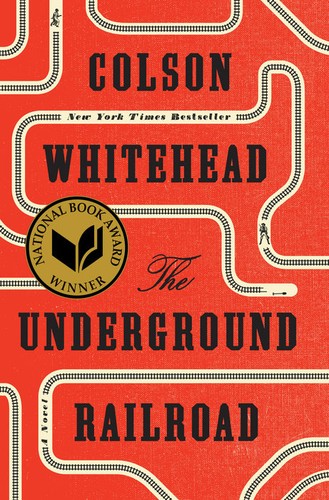
The Underground Railroad
Colson Whitehead (2016)
“America reimagined as a series of nightmares — each state a different way the same country has always found to destroy Black lives.”
This page prints on a single page. Use Ctrl+P / Cmd+P.
The Underground Railroad
Colson Whitehead (2016) · 306pages · Contemporary / Neo-Slave Narrative · 4 AP appearances
Summary
Cora, a young enslaved woman on a Georgia cotton plantation, flees north with a man named Caesar, discovering that the Underground Railroad is a literal subterranean network of tunnels and trains. Each state she passes through — South Carolina, North Carolina, Tennessee, Indiana — presents a different vision of American racism: medical experimentation, genocide, violent suppression, and liberal paternalism that ultimately fails her. Hunted by the relentless slave catcher Arnold Ridgeway, Cora fights to survive a country that has declared her property. The novel ends with Cora moving west, toward an unknown freedom, having survived everything America could build to stop her.
Why It Matters
Won both the Pulitzer Prize and the National Book Award in 2016 — only the second novel in history to win both simultaneously (after The Color Purple). Became one of the most discussed American novels of the decade, debated as both a work of literary art and a political document. Amazon adapted i...
Themes & Motifs
Diction & Style
Register: Formally plain — short to medium sentences, Latinate vocabulary used sparingly, no ornament for ornament's sake. The restraint IS the style.
Narrator: Third-person limited, rotating between Cora and occasional other perspectives (Ridgeway, Caesar, Mabel, Ethel, Royal)...
Figurative Language: Low to medium
Historical Context
Antebellum America (1800s) refracting all of American racial history: Whitehead explicitly collapses American racial history — slavery, Jim Crow, medical racism, lynching, the destruction of Black communities — into a single, compressed alternate past. Each state the...
Key Characters
Talking Points
- The Underground Railroad is a real historical metaphor that Whitehead makes into a literal physical fact. Why is this choice more powerful than keeping it metaphorical? What can a real train do that a metaphorical one can't?
- Each state Cora passes through represents a different American approach to the 'problem' of Black people. Map the states onto contemporary American racial politics. Which states feel most current?
- Ridgeway's 'American imperative' is presented as a coherent philosophy, not mere rationalization. Why does Whitehead give his antagonist a genuine intellectual framework rather than making him simply evil?
- Homer — a free Black boy who voluntarily chains himself to Ridgeway's service — is never explained by Whitehead. Why does the novel refuse to give Homer a psychology or a backstory?
- The Mabel chapter reveals that Cora's entire narrative motivation — the wound of having been abandoned by her mother — is based on a false premise. How does this structural revelation change your understanding of everything Cora has done and felt?
Notable Quotes
“The two brothers were different kinds of evil.”
“She grabbed a rock and hit him in the head. She hit him again.”
“The American imperative was a beautiful thing — a force of nature, like the wind that filled a ship's sails.”
Why Read This
Because it does something most historical fiction doesn't: it tells you the truth about American history by refusing to let you place it safely in the past. Every state Cora passes through is also the present. The spare prose means you can't hide ...