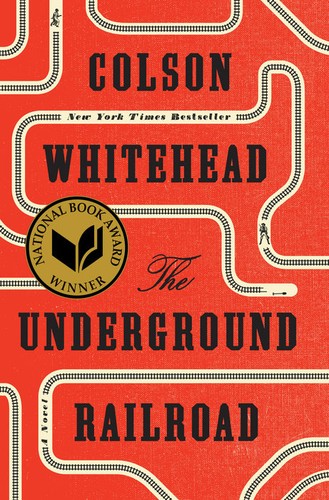
The Underground Railroad
Colson Whitehead (2016)
“America reimagined as a series of nightmares — each state a different way the same country has always found to destroy Black lives.”
Essay Questions & Food for Thought
30questions designed to challenge assumptions and provoke original thinking. These can't be answered from a summary — you need the actual text.
The Underground Railroad is a real historical metaphor that Whitehead makes into a literal physical fact. Why is this choice more powerful than keeping it metaphorical? What can a real train do that a metaphorical one can't?
Each state Cora passes through represents a different American approach to the 'problem' of Black people. Map the states onto contemporary American racial politics. Which states feel most current?
Ridgeway's 'American imperative' is presented as a coherent philosophy, not mere rationalization. Why does Whitehead give his antagonist a genuine intellectual framework rather than making him simply evil?
Homer — a free Black boy who voluntarily chains himself to Ridgeway's service — is never explained by Whitehead. Why does the novel refuse to give Homer a psychology or a backstory?
The Mabel chapter reveals that Cora's entire narrative motivation — the wound of having been abandoned by her mother — is based on a false premise. How does this structural revelation change your understanding of everything Cora has done and felt?
Compare South Carolina's 'progressive' racism (decent housing, education, sterilization without consent) to contemporary liberal institutions. What is Whitehead's argument about the relationship between good intentions and actual outcomes?
Whitehead wrote this novel over fifteen years and was afraid for most of that time that he wasn't ready to write it. Does the finished book show evidence of that preparation — or of that fear?
The novel ends with Cora moving west in a wagon train — toward no specified destination. Why does Whitehead refuse to give Cora an endpoint? What would be lost by ending with a place rather than a direction?
The Friday Night Festivals in North Carolina — public lynchings framed as community entertainment — are described in the same flat, documentary prose as everything else in the novel. What effect does this tonal consistency create?
The novel collapses multiple eras of American racial history into a single alternate past — slavery, Jim Crow, medical racism, the destruction of Black communities. What does this temporal compression argue about American racism?
Valentine Farm is destroyed by a raid because its prosperity was itself threatening. How does this connect to the actual history of Black community-building in America? Name at least two historical parallels.
Whitehead's prose is famously spare — no ornament, no elevated language around scenes of violence. Compare a scene from The Underground Railroad to a passage from Toni Morrison's Beloved. What does each author's stylistic choice argue about how to represent historical trauma?
Ridgeway tells Cora that she is 'part of the American imperative' whether she accepts it or not. Does the novel agree with him? Is Cora simply a piece of the system, or does she successfully refuse it?
The museum in South Carolina employs Cora to sit in a tableau vivant of 'Scenes from Negro Life.' How does this connect to contemporary debates about who tells Black stories, and for whom?
Caesar's backstory — promised freedom by a white benefactor, legally defrauded by her heir — demonstrates a specific pattern. Why is the gift of freedom that can be legally revoked worse than no gift at all?
The novel was published in September 2016 and won the Pulitzer in 2017. How does the political context of 2016-2017 America shape its reception? Would it be read differently if published in 2010?
Royal speaks in the future tense with genuine conviction — he believes in a future where Black people are free. His death is the novel's most affectively devastating loss. Why does Whitehead kill the most hopeful character?
Tennessee is a state ravaged by fire and plague — too broken to sustain ideology. What is Whitehead arguing by including a state that has passed beyond the point of coherent racism into pure catastrophe?
Compare Whitehead's Underground Railroad to the actual Underground Railroad as historians understand it. What does the fictionalization gain? What does it obscure?
The novel's narrator never editorializes — never tells you how to feel about what you're reading. How does this affect your emotional response? Are you more or less disturbed by a text that refuses to coach your reactions?
Cora's garden plot on the Randall plantation is her only inheritance and her fiercest attachment. Why does Whitehead start the novel with a territorial claim that small? What does it say about what ownership means when you own nothing?
Ethel dreams of bringing civilization to 'the Africans' while being unable to see the Black woman in her attic as a full person. How does Whitehead use her to critique a specific variety of white anti-racism?
Barry Jenkins adapted The Underground Railroad as a 10-episode Amazon series in 2021. The visual medium allows Jenkins to linger on faces, landscapes, and silences that the prose moves past quickly. What might the novel be able to do that the series cannot, and vice versa?
The novel won both the Pulitzer and the National Book Award in the same year. Name another book that achieved this, and compare the two novels' approaches to their central subjects. Why do prize committees respond to this kind of work?
Whitehead refused to research actual slave narratives while writing this book, fearing they would make him too cautious. How does this choice show up in the text — what does the novel permit itself that a more research-bound book might not?
The novel ends with Cora moving west rather than north. The historical freedom narrative is always: go north, toward Canada. Why does Whitehead change the direction?
Mabel's chapter is told in the past tense and is separated from Cora's sections structurally. Why does Whitehead wait until the end of the novel to tell us what actually happened to Cora's mother?
Whitehead has said that the novel is 'about America, all of America, all the time.' How does the magical-realist conceit of the literal railroad make this claim possible? What would be lost if the novel were set in the actual 1850s with realistic transportation?
Compare Cora to Sethe in Toni Morrison's Beloved. Both are enslaved Black women who commit or witness extreme violence in the name of freedom or protection. How do the two novels handle the psychology of trauma differently?
If you were to add a chapter for a state Whitehead omitted — your own state, or a state you know well — what variety of American racism would it stage? What is the specific American nightmare your state has produced or permitted?