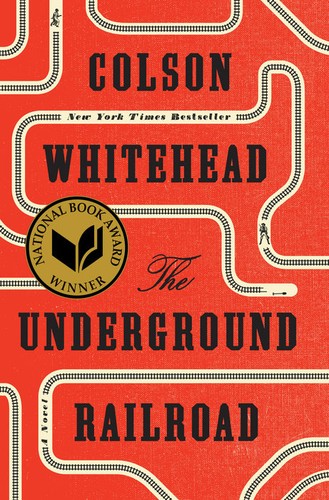
The Underground Railroad
Colson Whitehead (2016)
“America reimagined as a series of nightmares — each state a different way the same country has always found to destroy Black lives.”
The Underground Railroad— Historical Context & Author Background
Author: Colson Whitehead · Published 2016· Era: Contemporary / Neo-Slave Narrative·306 pages
Themes explored: slavery, freedom, race, violence, America, survival, history, escape
About Colson Whitehead
Colson Whitehead (born 1969) is a Black American novelist from New York City. He attended Harvard and worked as a critic before publishing his debut novel in 1999. He has described The Underground Railroad as a book he had been thinking about for fifteen years but was afraid to write — afraid he wasn't good enough, afraid of what the research would require of him emotionally. He wrote it after Obama's presidency and published it in September 2016, two months before the 2016 election. It won the Pulitzer Prize and the National Book Award simultaneously — only the second novel ever to do so (the first was The Color Purple). Barack Obama named it among his books of the year. Oprah selected it for her book club. Whitehead won a second Pulitzer for The Nickel Boys (2019), becoming only the fourth author in history to win two Pulitzers for Fiction.
Life → Text Connections
How Colson Whitehead's real experiences shaped specific elements of The Underground Railroad.
Whitehead spent fifteen years afraid to write this book, believing he wasn't ready
The novel's refusal to soften or sentimentalize — it reads like a writer who decided not to protect himself or the reader
The delay is audible in the prose: this is not a first attempt. Every choice is deliberate, including the restraint.
Written and published during the Obama era, released just before the 2016 election
The South Carolina chapter's 'progressive' racism — benevolent, institutional, liberal — reads as a comment on Obama-era racial politics
The novel refuses to locate racism only in the past or in the explicitly monstrous. South Carolina is now.
Whitehead's background as a literary critic and his Harvard education
The novel's self-conscious engagement with the neo-slave narrative tradition (Morrison, Styron, Octavia Butler) — Whitehead knew the genre before he wrote in it
He makes deliberate formal choices against that tradition: no hallucinatory prose, no mythic register, no maternal trauma as the central horror.
Historical Era
Antebellum America (1800s) refracting all of American racial history
How the Era Shapes the Book
Whitehead explicitly collapses American racial history — slavery, Jim Crow, medical racism, lynching, the destruction of Black communities — into a single, compressed alternate past. Each state the characters pass through is not one historical moment but many: North Carolina is sundown towns AND the expulsions of Reconstruction AND the violence of Jim Crow. The novel refuses to let American racism be safely distant in the past by making every form of it simultaneous.
Why The Underground Railroad Matters Historically
Won both the Pulitzer Prize and the National Book Award in 2016 — only the second novel in history to win both simultaneously (after The Color Purple). Became one of the most discussed American novels of the decade, debated as both a work of literary art and a political document. Amazon adapted it as a 10-episode series directed by Barry Jenkins in 2021. Regularly cited in discussions of the neo-slave narrative and of how fiction can address history that nonfiction cannot fully contain.
- One of the first novels to literalize the Underground Railroad metaphor — treating the known metaphor as a real physical infrastructure
- The second novel to win both the Pulitzer Prize and National Book Award in the same year
- Pioneered the 'state-as-chapter' structure as a way of mapping American racial geography across time
Challenged in several school districts for graphic depictions of slavery, violence, and racial terror. Supporters argue that the graphic content is the point — sanitizing the novel would sanitize the history. The debate about the book in schools often mirrors the debate the book itself stages: who decides what is too difficult to see?