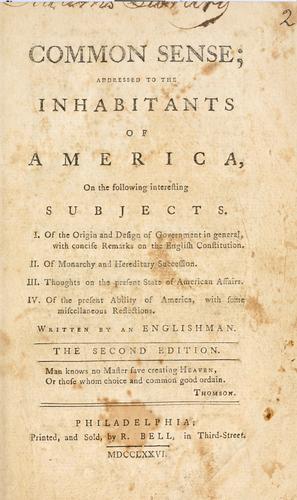
Common Sense
Thomas Paine (1776)
“A broke, self-taught immigrant writes 48 pages that convince an entire continent to declare independence — and publishes them anonymously because the argument matters more than the author.”
At a Glance
Published anonymously in January 1776, Common Sense is the pamphlet that turned colonial grievance into revolutionary conviction. Thomas Paine — an English immigrant who had been in America barely fourteen months — argued in plain, furious prose that monarchy was absurd, hereditary succession was criminal, reconciliation with Britain was impossible, and independence was not merely an option but a moral obligation. Within three months, 150,000 copies were in circulation in a population of 2.5 million. Washington had it read aloud to his troops. It did not propose independence as a theoretical ideal; it demanded it as an immediate, practical necessity.
Read full summary →Why This Book Matters
Common Sense is the most influential political pamphlet in American history and arguably in the history of the English language. It sold approximately 150,000 copies within three months of publication — in a colonial population of 2.5 million, roughly one copy for every sixteen people, the equivalent of selling 20 million copies today. More importantly, it changed the terms of the debate. Before Common Sense, the question was whether to reconcile with Britain on better terms. After Common Sense, the question was how to build a new nation. The Declaration of Independence, drafted six months later, echoes Paine's arguments, his rhetoric, and sometimes his exact phrases. John Adams admitted that without Paine's pen, Washington's sword would have been raised in vain.
Diction Profile
Deliberately low for its genre — Paine rejects the Latinate, legalistic prose of prior political philosophy in favor of short sentences, common metaphors, direct address, and controlled insult. The plainness is itself a political act: it says that political truth belongs to everyone.
Moderate but concentrated