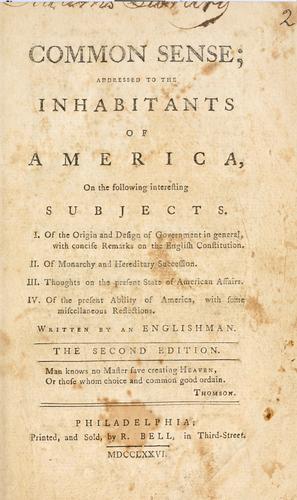
Common Sense
Thomas Paine (1776)
“A broke, self-taught immigrant writes 48 pages that convince an entire continent to declare independence — and publishes them anonymously because the argument matters more than the author.”
For Students
Because every political argument you will ever encounter uses the same tools Paine used — appeal to principle, appeal to emotion, appeal to self-interest, appeal to urgency — and Common Sense is short enough to watch all of them deployed in 48 pages. Paine does not hide his techniques; he performs them openly and trusts the reader to be persuaded anyway. Understanding how Common Sense works is understanding how all political persuasion works, from campaign speeches to social media threads. It is also the most important text for understanding why the United States exists as an independent nation rather than a British territory.
For Teachers
Common Sense is the ideal text for teaching rhetoric, propaganda, and the relationship between style and argument. Its four-section structure maps cleanly onto the progression from philosophical principle to practical action. The plain style is itself teachable — students can identify every technique Paine uses (metaphor reversal, biblical authority, direct address, controlled insult, urgency) and debate whether each is legitimate persuasion or manipulation. The comparison with the Declaration of Independence reveals how Paine's popular rhetoric was formalized into legal-philosophical language. The text also raises essential questions about anonymous publication, the ethics of one-sided argument, and the relationship between writing and political action.
Why It Still Matters
Common Sense is the template for every revolutionary argument ever made in English. When someone argues that the current system is broken beyond repair, that reform is impossible and only radical change will serve, that the moment for action is now and delay is cowardice, that the cause is not local but universal — they are repeating Paine's structure whether they know it or not. The pamphlet is also a warning: Paine's arguments are one-sided, his evidence is selectively deployed, his emotional appeals are calculated. Common Sense works because it is brilliant rhetoric — and rhetoric that works this well should make the reader both thrilled and uneasy.